Showing posts with label PSN. Show all posts

Thursday, 27 January 2011

Meet the NGP

PSP successor confirmed

About five hours ago, Sony held a press conference in Japan to announce the PSP2, also known as the NGP (Next Generation Portable). Given that the current PSP had its share of misguided flaws, especially the PSPgo, it's encouraging to browse through the features currently announced and see that Sony has managed to fix a few of them, especially when I look back through my wish list of PSP2 features from early last year; there's no Cell processor in there, but a quad-core ARM processor will do just as nicely. And there's a few other things that have left me feeling impressed:

A touch pad on the rear

I called this months ago, less because I thought that Sony would actually implement it and more because it's a great idea; frankly, its inclusion has given me hope that Sony still has it in them to deliver smart hardware choices that its rivals don't offer, after playing catch up for the last few years with the PS3 and generally flailing about with the PSP.

Anyone with a modicum of hand-eye coordination will be able to match their fingers behind the console to points on the screen in front of them, theoretically meaning that we could play fully-functional touch screen games without our fingers obscuring and smudging the screen. This is a step forward that not even Apple have thought to do yet, and if it works it'll reflect well on Sony as a console maker.

Flash card storage for games, updates and DLC

The removal of the UMD is no great loss, but even better than the switch to flash drive is that all updates and DLC will be stored and integrated with the game on the same cartridge, making data transfer between systems an absolute breeze. The original PSP stores such data on the memory stick, which means that actual downloaded games tend to get lost amidst a forest of separate icons for updates and DLC; it may amount to housekeeping more than anything else, but for the sake of convenience this is an important feature.

Infinitely better analogue sticks

Aside from the fact that there are two of them, pictures clearly show that the analogue sticks are just that: proper sticks, not just sliding nubs that cripple your thumbs. They'll be more prone to damage when being shoved in bags or pockets, but I'd be very surprised if the inevitable carry cases don't account for that.

Key franchises right from the off

Enough said. Even if they don't make the console's launch, names like Killzone and Uncharted carry a lot of weight. The fact that they're on their way and comparable to their PS3 counterparts is enough to have faith that the console will have a few essential titles in its first year.

No news yet on the price (expensive) or battery life (short) or even the release date (er... not yet), but head over to Kotaku for big, glossy pictures of the unit. It sounds like a console with potential, and it'll remain to be seen if Sony can overcome its predecessor's stagnation and keep pace with the 3DS. Expect to hear more about this in the coming months.

Friday, 8 October 2010

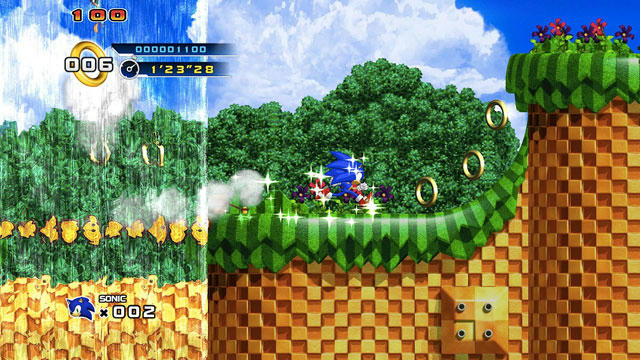
Sonic 4: Episode 1

After years of experimenting, Sega return to what they know best

Let's start with some context: I have roughly a dozen beta versions of Sonic 3, including the 3c beta that represented Sega's last-ditch effort to fit the game on to one cartridge before splitting the second half into Sonic & Knuckles. I have a screencap of the old Sonic 1 title screen where Sonic had a human girlfriend called Madonna. I know that in the first teaser trailer for Sonic 4, they used Sonic's beta sprite from Sonic 2 instead of the one that made it into the finished game. Sonic Crackers, Sonic-16 and Sonic Eraser - every one an obscurity, and still I hunted them down.

Now that we have my fanboy credentials in order, I have to say that as much as I still enjoy the original games, they're not so perfect that a reinvigorating update isn't in order. The physics are far too weighty, there's not much in the way of collectables, and later titles like the Advance series showed that there's more to be wrung out the classic Sonic template with newer tech. And Sonic 4 does exactly that.

Following directly on from Sonic 3 and its follow-up Sonic & Knuckles, this is Sega's take on New Super Mario Bros - a fusion of classic gameplay with more modern series elements, and for once the intrusions into the Sonic formula blend together well. Get stuck on a slope in 1991 and you were due a tedious traipse back down the hill so you could get some speed up. In 2010, Sonic feels far lighter and nimbler, practically skipping from one platform to another, yet his top speed is still limited to accommodate the multi-path exploration that made his classic titles feel so adventurous. Homing attacks and speed boosters are present from his Adventure days, but they're complementary rather than essential, letting Sonic hit springs instantly and jump to full speed without his trajectory or lack of inertia breaking flow where once it would have.

This fusion pervades Sonic 4, from gameplay to visuals; netting a continue gives you the same miniature Sonic sprite and celebratory jingle from Sonic & Knuckles, as pixellated and imperfect as ever, and it feels genuinely charming when it could have been glaringly out of place. The music comes as a slight disappointment then, given that it occasionally falls into the territory of imperfect imitation that the rest of the game so skilfully avoids, but there are a few jingles that rank among the franchise's best, and fans are sure to notice the tap-tappy drum beats of the Megadrive sound bank. It's a niggle that is noticeable purely for the quality around it, and that's something we haven't been able to say of Sonic in years.

Which isn't to say that the design is airtight and seamless, mind you; the balance between obvious imitation and fitting homage is definitely skewed the wrong way at first, but manages to right itself as the game goes on. The physics are reasonably well judged but wildly inconsistent, with Sonic happily strolling up vertical surfaces, and while segmenting the bosses into two slightly different forms has been a staple of the 2D games since Sonic Advance, it at least came with some amount of subtlety back then rather than drawing as much attention to it as possible; Sonic 4 occasionally lays on its new-and-old veneer a bit thick, but with fans baying for the old days, this is probably the closest Sega can come to recreating the feel of the original games while keeping things slick enough for newcomers and those who are slightly less anal about the hedgehog's past.

2010 seems to be the year that Sonic fans have been waiting for - consistently positive coverage of what could be the first genuinely excellent 3D game, Sonic Colours, and a strong retro revamp in the second dimension. I never felt that the 2D games needed fixing, and would still love to see more from the Advance and Rush series, but not only is Sonic 4 a tidy and fun title, it also demonstrates a keen awareness from Sega of every age their flagship franchise has gone through. That alone may be the key difference that has so suddenly changed Sonic's fortunes, and long may this new state of play continue.

Verdict
Sonic 4 isn't ground-breaking or innovative, but it is great fun and so very, very Sonic. A fitting start to the successor of the Megadrive classics, if a little pricy for its length.


Sunday, 1 August 2010

Earthworm Jim HD

A perfect conversion - but is it still a perfect game?

Reality just can't match the wackiness of cartoons, which is pretty much why they still exist. The incredible horsepower of modern consoles has been good to us, but while modern remakes of Mega Man X and Castlevania have stayed true to their source, it's a rare LittleBigGame that captures the soul of pastel-bright animation with polygons.

After years of 2D remakes in 3D clothing, it's refreshing to play a retro classic so obviously in love with its roots. For better or worse, Earthworm Jim HD is as beautiful, manic and frankly insane as the day it was made; the original captured Saturday morning cartoon visuals perfectly, and they are all the better for being in HD. Jim's animations are easily the match of contemporaries like BlazBlue, and the high fidelity polish has been applied to visuals and sound alike.
Jim has aged well, then. But if we're being brutally honest, his first outing wasn't without its problems, and while they haven't really gotten worse with time, they're just as annoying as you remember them. A useful edge-grab that hoists you back on to platforms is all that stands between you and a controller-damaged flatscreen, as you struggle constantly with collision detection apparently designed to mock everything that decades of gaming have taught you. There's little to the controls beyond jumping, swinging and shooting, yet hitting enemies is a pain, targeting swing points is finicky and you always seem to fall off platforms with one step left. A pixel-perfect update is no bad thing, except when a touch more pixel-perfection would have improved things by a small but significant margin.

The best example is For Pete's Sake, where you aim to protect Peter Puppy as he skips obliviously through meteor showers, pitfalls and killer plants. The meteors will break your thumb, as you have to cycle through at least three directions of fire with the d-pad, fast enough to create a barrier against the relentless hail of rocks, while the precision needed to keep Peter Puppy on solid ground verges on the ridiculous. Combine this with a badly overused chase level, occasionally aggrevating bosses and some truly obnoxious enemy placement, and you'll begin to appreciate why no-one feels nostalgia for the patience needed of the mid-'90s gamer.

Which isn't to say that Jim HD is a bad game, merely one that approaches its conversion a little too perfectly. Bungie-battling over a monster infested lake and riding a bloodthirsty hamster are as fun today as they were yesterday, and as with all games of its kind, practise eases the pain. A brand new multiplayer mode and three exclusive bonus levels show that the series is still capable of its own creative flair; an ill-judged Keyboard Cat parody comes across as a little sterile, especially compared with the game's own Evil the Cat, but head-whipping a demonic granny into fumbling for her glasses is classic Jim all over. It bodes especially well for an updated sequel, which was a distinctly tighter package all round, and a brand new instalment hasn't been ruled out. Jim HD is by no means a perfect game, but as a timely reminder of the joyous insanity that gaming used to revel in, it's the perfect nostaliga piece.

Verdict
Too stubborn to make the improvements it needs, Earthworm Jim HD manages to hold up well nonetheless. The low price point should make it an obvious purchase for fans, and a consideration for others.

Saturday, 24 July 2010

Mega Man Universe Announced

The Blue Bomber returns, confuses millions

What the hell is Mega Man Universe? Just about any theory based on the mystifying teaser trailer is plausible, from a Mega Man-centric Capcom nostalgia-fest to a LittleBigPlanet DIY version of the standard Blue Bomber experience.

Given that it is being developed for download on PS3/360 but NOT for Wii, could it (whisper it) be an Invisimals-style affair for Xbox Kinect and Playstation Eye, using the gamer's lounge as a playing environment, or using real world objects for Mega Man's weapon upgrades? With everything from claymation to cardboard cutouts gracing the trailer, and the tagline 'Your world. Megafied', it's as good a theory as any. Hell, MMU could be a mash-up of every rumour going. Mega Man may not have the status to spark a thousands rumours from one game title alone, but an equally mystifying interview certainly seems to have done it.

Mega Man Universe is due for release on 360/PS3, with a date yet to be nailed down. Expect a preview later in the year.

Sunday, 18 July 2010

Preview: LittleBigPlanet 2

It does credit to the community surrounding LittleBigPlanet that, having so thoroughly exhausted the vast resources available to them, a sequel is warranted just two years later. A constant stream of DLC has swelled the enormous arsenal of textures, stickers and other creative pieces that have contributed to almost three million user-created levels, spawning at a rate of almost four thousand per day; LBP must surely rank with Second Life and Garry's Mod for sheer unbridled passion from its fanbase, to the point that a game that didn't seem to warrant a sequel this generation is in sudden need of one.

While LittleBigPlanet aimed to let players create stand-alone platform levels, enthusiasts soon started exploring far beyond these bounds, with working calculators, side-scrolling shooters, musical renditions and a complete recreation of Contra emerging from what is essentially a digital mash-up of Lego and Mechano. With that in mind, Media Molecule have begun removing the limiters from their saccharine marvel; a flexible camera allows for top-down gaming and fully directable cutscenes, logic-based AI makes the fiddly task of programming complex enemies a much simpler task, and new options allow for entire games to be created, not just individual levels.

The core of the game remains unchanged, but as with the original, a myriad of features both great and small are likely to be explored in amazingly creative ways by a community that is hungry for more. The visuals have been given a subtle overhaul as well, with the engine from God of War 3 giving a much smoother and softer edge to the atmosphere, and hopefully eliminating the occasional slowdown issues that an overly-ambitious level could generate. Even in pre-release shots, the game is noticeably prettier.

LittleBigPlanet 2 is set for release in November, and if the last two years have taught us anything, PS3 owners are about to be surprised in ways they never thought they would be, all over again.

Tuesday, 16 February 2010

Dude, Where's My Remote Play?

Neglecting an unexplored treasure of the PSP is one of Sony's biggest mistakes

Of all the features the PSP sports, Remote Play is one of the most useful and by far the most neglected. It allows you to control your PS3 using the PSP as a controller, and in exchange beams the sound and video from the PS3 straight back to the PSP's screen, rather than your TV. It gives you a fully functional Playstation 3 in the palm of your hand, whether you're on the bog or halfway across the world. In theory, that is.

Given that the majority of remote access software on cutting-edge PCs rarely let you see the desktop background on your computer back home, I'd have expected Sony to be shouting from the rafters about Remote Play, especially given that it was already proving its potential in 2007's Lair. For me, it was a huge selling point for the PSP, at least until I discovered that the number of games that support it are huddled in a terrified group amongst the ever-growing hordes that don't.

Sony have spent so much time transforming the two consoles individually that they seem to have forgotten just how much of a pairing they are. Same interface, same broad expansion into generalised media hubs, same emphasis on high-powered gaming, with online at the heart of the experience. The more the two consoles grow the closer they become, and it seems odd that this parallel development isn't being allowed to jump tracks more than it is. Just look at the compatibility list for Remote Play: some PS3 games will work, if devs can be bothered. But no PS2 games. Or Blu-Ray films. Or protected content. Well, at least PSone games work, but you'd be hard pressed to find more than ten people for whom playing games from the time of blocky 3D dinosaurs was their primary reason for buying a PSP. Or a PS3, for that matter.

It's not as though cross-console partnerships are a revolutionary idea; Sony themselves created the PocketStation, a miniature LCD egg that mimicked the Tamagotchi in design and allowed players to buff up their character in Street Fighter Alpha 3 and send their chocobo from Final Fantasy VIII on a mini adventure. Sega were the true innovators in this field with the Visual Memory Unit (VMU) for the Dreamcast, a super-charged memory card that had few uses other than low-res screensavers during most games thanks to developers who had little cause to use the screen for anything else, but it was still handy for browsing saves and acted as a handy reference for stats in games like Resident Evil 2. Sega's interest continued even after their own hardware had folded, and players could send their Chao to-and-fro between the Adventure and Advance iterations of the Sonic series to be trained and raised in two distinctly different mini-games, just like they had done on the VMU. In the present era we have the PSP, a fully-fledged handheld with game-sharing functions that allow players to send portions of a game to another player, enabling multiplayer or demo downloads without the need for two copies of the game. So why has the promise of generations gone by been ignored, when the functionality not only exists but continues to be exploited in other forms? Where is that rear-view mirror we were promised no less than four years ago?

An argument can be made that the PSP lacks some of the PS3's buttons, making remote play a difficulty, but that's a pretty poor argument. When the DualShock was released, did studios the world over throw up their hands and screech "Another pad? Now what are we going to do?!"? Of course not. They calmly and without any fuss made two control schemes - one analogue, one digital. Two generations later and we can't do a little extra button mapping, or nudge the HUD about so it fits better on a smaller screen? That would take less effort to implement than the mandatory Achievements (and now Trophies) thrust upon games in the last few years, and less thought as well.

At least Singstar works; but wait, what's this? You can browse for songs, but can't actually play? Why not? The two consoles can surely work out the ping rate (the delay between data being sent from one device and coming back again) between the two, and adjust the leniency of the game to prevent players from failing unfairly due to a poor connection? Even Guitar Hero lets you set the lag between you pressing a button and your TV displaying it, down to the millisecond, and the only reason it asks YOU to define it is because it doesn't know itself; when the consoles can take these readings all by themselves, and given that later builds of the PSP include a built-in microphone, what reason is there to deny the player the chance to Singstar their heart out in Tanzania while their PS3 is stuck in Blighty? At the very least it's a fascinating experiment in the limits we can stretch console gaming to, and with OnLive preparing to switch on during 2010, Sony have the chance to ride the wave with their own take on the concept, possibly even upstaging OnLive in some small measure by showing off what their own hardware can do.

It isn't a hopeless case; Sony certainly seem to recognise the benefit of cross-hardware hook-ups, with the MediaGo application for sorting the PSP's media from your desktop, and media sharing for the PS3. Even more promising is adhoc Party, an app for the PS3 that lets you run local multiplayer functions on the PSP over the internet by using the bigger-brother console as a hub. Adhoc Party is an inspired idea that especially helps out western gamers for whom adhoc gaming is largely a pipe dream, and shows genuine thought into what a PS3-PSP union can achieve in the right hands. It only remains to be seen what direction Sony takes in 2010, and with Nintendo hinting that a DS successor could be announced in the coming months, Sony will be under pressure to announce a rival. If they remain true to form it will be stylish, expensive and ready to exploit what Nintendo can't or won't offer. And with the current gen in full swing and online firmly at the centre of the HD console wars, there is no better time for Sony to re-evaluate the potential of their handheld.

Saturday, 28 February 2009

Noby Noby Boy

The creator of Katamari tries for brilliance and comes up short

Katamari was a slice of pure, distilled insanity, but on some vague level it still made a strange sort of sense to roll around in a giant, planet-purging ball like those rollers for removing cat hair. It may have had madness slathered all over with an over-enthusiastic trowel and it may have been a glorified way of getting you to do the hoovering, but at least there was method to Katamari’s madness. And if Noby Noby Boy is anything to go by, method is increasingly the last thing on Keita Takahashi’s mind.

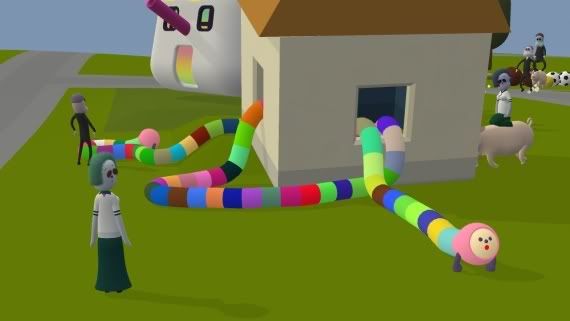
To call this thing a mess would be doing it a kindness; absolutely nothing about it makes sense on any level. The titular Boy is a small pink phallus who lives in a dimension-warping house that spurts out bubbles, and spends his days eating bicycles and shitting them off cliffs. The left stick moves your ass (figuratively), the right stick also moves your ass (literally) and a combination of the two lets you part buttocks from brain cells and stretch to enormous lengths. The face buttons see almost no use, while the shoulder buttons are used for everything and often require you to perform both actions and camera control at the exact same time. If that sounds unnecessarily complicated then you’re in possession of a few marbles more than the dev team.

You could be forgiven for thinking that Takahashi had no clue what he was doing with Noby Noby Boy for the entire length of its development, and it shows. Camera control involves so many different combinations of buttons and analogue movement that the chances of you even vaguely aligning the camera as you want it are almost nil, not least during those moments when the camera decides to leave you running about off-screen before finally deigning to swing round in your general direction. Menus are even worse; scoffing at the ridiculous notion of having everything laid out in neat sections, Noby Noby Boy forces you to control a 2D version of yourself who runs rampant through the text, barging letters out the way and occasionally eating them for good measure. The fact that you can drop him behind the text where he can’t do any damage is a blessing that soon fades as you realise that a game with nothing to do has hundreds of lines of text to wade through in a long and pointless list in order to tell you about it. And that’s assuming you’ve had the patience to sit through the first loading screen, which must surely last longer than that of Fallout 3, a game one thousand times the size and with a thousand times the detail of Noby Noby Boy, as well as approximately the same load times; it doesn't take a startling measure of intelligence to see that there is something desperately wrong here.

There’s not even a thing to do once you hit the game proper. People sit on your body for shits and giggles, then run away the next minute as you chow down on their friends and watch them collect in lumps at the base of your body. Then you fire them out your backside, and they go about their day. That’s it, mission accomplished; go to the next level and repeat until a vegetative state kicks in. Maps generally feature at least one or two potential points of interest, such as UFOs with claws hanging underneath and giant springs with balls balanced on top, but you can’t do anything with them. They just sit there as a mocking reminder of what happens when you let a genius squander two years on something that should have been knocked up in half a year by a penniless indie team.

Noby Noby Boy has one saving grace in the name of longevity, and that is its genuinely intriguing method of progress. By jumping repeatedly, both Boy and his buttocks can fly up through the cold, empty sky to meet the Sun, who lets him give up whatever body length he has achieved and add it to the length of Girl, another penis-shaped monstrosity who grows like Pinocchio’s nose (among other things) through space. With her overall length being contributed to by every player, Girl is already getting pretty sizable at several hundred million metres, and just recently made it to the Moon! Congratulations to everyone involved! Takahashi claims that by reaching new planets there will be new content unlocked, but since the Moon levels offer nothing that the original levels didn’t I highly doubt that such a thing as ‘content’ will ever grace Noby Noby Boy.

It’s hard to know what else to say; the game is simply a mess at every step. The controls are horrendous, the menus confusing, the load times ridiculous, and the content non-existent. Artistic vision gets so badly in the way that the whole thing suffers at ground-level. Even the most meandering and pointless game ultimately has something to work for, a point which Noby Noby Boy illustrates with aplomb by ensuring that the new levels opened up by Girl’s trip to the Moon offer absolutely nothing new. It has a unique and quirky charm that’ll keep you smiling for whole minutes at a time, but once you’ve eaten a few chickens and waddled off the level edge a couple of times you‘ve seen the lot.

People are already throwing excuses at it: ‘it’s not meant to have a point, it’s just throwaway fun’, and ‘it’s quirky and cute, that’s all that matters’. And that’s all they are: excuses. Noby Noby Boy has been in development since at least mid-2007, and the result of this endeavour is a lurching monstrosity of an engine that can’t load a tiny, textureless patch of land faster than Fallout’s immense, post-apocalyptic landscape, a terrible control set with barely a grain of thought behind its layout and an experience ripe for interesting quirks that tantalises but never lets you touch.

At £3.19 it’s unlikely to make you feel desperately robbed of your cash, and it at least admits its incomprehensibility right off the bat, even if it’s less willing to acknowledge its many technical issues and design faults. If scooting your ass away from your body and farting out bicycles sounds like the greatest use of your time since discovering the pin number for the locked channels on Sky, then by all means spend your money and be entertained. Just don’t expect the fun to last long, or for the global progression to bring anything new to the table.

Verdict
Big on charm but small on everything else. At a miniscule price point you might as well give it a whirl if the fancy takes you, but hopping on Youtube will tell you everything you need to know within a minute. As much as it wishes to rank itself amongst the elite of quirky gaming, it misses the point entirely by not even having one. With no substance behind the style, it is a missed opportunity.