Friday, 9 April 2010

Final Fantasy XIII

The veteran series comes over all Football Manager

That a new Final Fantasy is polarising is news to absolutely no-one; the series has practically invited it by winning devotees with each entry, then reinventing itself for the next. Every fan has their favourite and their most hated, and the latest installment is no different.

Square-Enix's latest has all the potions, Shivas and chocobos you've come to expect; as always, no matter what the changes, the game is still a Final Fantasy through and through. What has made FFXIII the definitive Marmite entry of the series, though, is just how far they've gone in uprooting the mechanics of the JRPG.

For starters, the game is brutally streamlined. NPCs say their piece when you walk past with no chance to engage in dialogue, towns are little more than monster-free window dressing and shops are accessed through save points, and there are few enough of the first two. The limited exploration and idle chit-chat that flesh out RPGs take place almost entirely through cut-scenes, with a rich backdrop always being at the forefront of the story while never actually getting you involved.

It's a slap in the face for gamers who value the immersion these elements bring, but in many ways the game is better for it. For starters, the cast is the best since Final Fantasy VII; thrown together for a variety of reasons, the anger, resentment and inner conflict that both drives them and separates them is well realised; narrative lead Lightning takes her cue from series predecessor Cloud, but her flaws are much more relatable and human, and rather than fulfilling the classic JRPG archetype of the silent loner who learns to open up, she begins her quest for redemption much earlier in the game, and her helplessness as her efforts cause more turmoil that she is emotionally unequipped to deal with is extremely touching. After several games where the characters were relatively chummy, it is refreshing for the cast to be caught in the same quest, yet be utterly divided in their motivations and goals.

The narrative is helped along by a game that is paced significantly better than previous entries, and the world is rarely broken by anything as videogamey as a textbox from loitering NPCs; the lack of shopkeepers is more than made up for by the digital store-fronts, which are clearly a labour of love, and basic tasks like party management and weapon upgrades are a quick in-out job that let you concentrate on actually playing the game. In truth, the game plays a lot like FFX with the edges smoothed to a frictionless sheen; that is, until you hit the battles.

While FFX stripped away the time-sensitive gameplay of the ATB bar, the thirteenth installment does a swift 180 and hurtles over the opposite horizon. The ATB bar is now segmented, allowing for multiple attacks that take up a portion of the bar. Everybody attacks whenever they like, and the resulting clusterfuck makes for some of the most beautiful battles you've ever seen; characters dash and dodge, somersault and spin, and never will you see two opposing forces lining up and taking it in turns to club each other before returning to their designated spot. The tiresome old bugbear of watching a character swing a sword clean through an enemy as the word MISS pops up on screen has been largely banished, with most dodges occuring as your party leader somersaults clean over attacks purely out of happenstance. For a game that is still fundamentally turn-based, it does a better impression of a real-time action game than most action games do.

But with such explosive and balletic eye-candy, the entire focus of combat has changed. You only control the party leader, the AI doing an excellent job of managing your teammates, as well as your own actions when you pick the default Auto-Battle command. At first it seems as through the game is playing itself, but once you get a few hours in and the abilities start piling up, as do the number of enemies and the range of tactics you need to apply, it becomes clear that FFXIII plays less like a JRPG and more like a management sim.

The reason the battles are so gloriously eye-catching is because for the first time in a Final Fantasy your eye is constantly on the battlefield, not just the stat bar. Numbers and skill names fly up alarmingly fast, and to stay on top you need to watch the screen like a hawk, making quick reactions on the fly, and the Auto-Battle quickly becomes a godsend that lets you take stock of your current situation. The focus of combat is the Paradigm Shift, which determines the current role of your characters and the range of abilities they can perform; setting your party's Paradigms before battle lets you switch from a Commando-Commando-Ravager combo for all-out assault, to a Synergist-Sentinel-Medic selection to buff and heal your party when things start going bad. Because each Paradigm allows for only certain skills to be used, making smart decisions with your pre-battle preparations is crucial to pulling off the right combos in every fight, and the result is a Final Fantasy that demands on-the-fly tactical changes to a far greater extent than any other entry in the series, even if the majority of your actions are hand-picked by the AI.

The changes in FFXIII are at once small yet wholly game-changing; the initial linearity of FFX has been streamlined even more, and the Gambit system of XII has been tweaked from a slow-paced and methodical style of combat to one of the smoothest and most energetic gaming experiences of this generation. Square-Enix's latest is a Final Fantasy through and through, but relatively small changes, applied numerously with thought and care, have created a whole new breed of JRPG that hides traditional gameplay beneath a slick, modern game mechanic. Certain deviations from the formula act as stark reminders as to why they existed in the first place, but FFXIII is still a game changer that shows a stubbornly traditional genre just how much you can do with an aging style of play, and complemented with an excellent story, beautiful graphics and a genuinely human cast of characters, FFXIII has more than enough substance to carry you through to the end.

Verdict
Well paced gameplay and an engaging story complement a well-thought out combat system. For those who found previous entries too static and dull, this could be the one to change your mind.

Tuesday, 23 March 2010

Yes on 3DS

Why the cynicism? Nintendo finally have their eye in for smart hardware, and the 3DS should be no different

After six years, four releases and 125 million units sold, Nintendo have announced the 3DS, a brand new 3D-enabled iteration of the DS family. It is likely to be an evolution in the same vein as the Gameboy Advance, upping its horsepower and features but not trying to be quite the game-changer that the DS proved to be.

Details on its 3D capabilities are sparse, but with true 3D technology still very expensive, initial rumours point to Nintendo doing a DSiWare and fitting both screens with cameras (and possibly an accelerometer) to track the player's head and eye movement, letting the game adjust the image to seem as though you're peering around a 3D space. It's a cheap alternative to 'real' 3D and not as convincing, but for fooling the eye and creating a strikingly responsive sense of depth, it is more than enough for a handheld console and should keep costs down to a minimum.

Opinions have been mixed, with a fair amount of scepticism occupying the middleground and other gaming sites being completely divided. I remain optimistic though, for these reasons:

1) We don't need another revolution yet

For better or worse, Nintendo have changed the face of gaming this generation. Aside from drawing new crowds to the gaming scene, they've shown that what should have been niche control schemes could be mass-marketed, as well as producing some excellent games that simply wouldn't have been as fun otherwise. With touchscreen and motion control only just beginning to dig in, there simply isn't any need for the 3DS to revolutionise in the same way. Whether it does or doesn't, it's all good.

2) There are plenty of gaming applications, in the right hands

Okay, most devs aren't going to make a lot of 3D besides window dressing, but the DS has played home to some truly excellent games such as Elite Beat Agents and Metroid Prime: Hunters, both of them excellent ambassadors for touchscreen gaming. Super Paper Mario and Echochrome both play with perspective, and both could do so much more with real-time 3D trickery. Items and secrets could be hidden from view, puzzle games could add an extra dimension of difficulty, and true outside-the-box developers like Hideo Kojima, a man who used daylight as a game mechanic, could doubtless find new and interesting ways to work with it. This isn't just about prettying up the graphics; with a little creative flair, 3D could make our games a lot more interesting too.

3) Both DS and PSP changed the importance of handhelds

The PSP has kept pace with the PS3 in the range of games, services and features that it offers, and as I suggested in my feature on Remote Play, a little extra bonding between the PSP and its big brother could make the handheld indispensable. The DS, meanwhile, is arguably superior to the Wii; both changed the gaming landscape, both brought in whole new audiences to gaming and both got bogged down with shovel-loads of crap, but the DS has emerged with a much stronger library of games, with traditional titles like Metroid Prime: Hunters and Mario Kart DS scaling down so well that they rank as two of the best titles in their respective series'.

Whatever way you look at it, handhelds are bigger now than they were at the start of the decade, not least due to the sudden minimising of hardware with smartphones and netbooks, and that means Nintendo have 125 million fans to please, for many of whom graphic alone aren't a key consideration. 3D needs to have potential as a key hardware feature, not just as a gimmicky graphical upgrade.

4) The palm of your hand is the saviour of 3D

Sky are launching their 3D TV channel later this year. There's only one slight drawback, which is that the industry is hopping on the 3D wagon trail about five years too early, and even commercial 3D televisions that don't require a pair of stupid glasses can't display HD visuals and require you to sit in fairly specific places relative to the screen in order to see the effect in the first place. Sheer convenience is a pretty important factor for a lot of people, hence why music CDs and printed newspapers are slowly dying a death in favour of digital distribution. Asking people to slip on a pair of glasses every time they want to watch TV is like requiring that they wear headphones if they want to hear sound or forcing them to push buttons on the TV instead of using a remote control; speakers and remotes were invented for a reason, and until the glasses barrier is taken down, 3D is going to have a hard time selling itself in the home.

Portable devices are a different matter, because the small screen does away with the problem of viewing from an odd angle, or having to worry about multiple people watching at once, or even producing fully HD visuals; mobile phones are being produced that won't require glasses, and although the price will be high by mobile standards, the impact of the iPhone means that high-priced cellphones are now a viable purchase, so long as they offer enough for the money. Even if the 3DS doesn't display 'true' 3D, it could be a striking example of the benefits that 3D brings.

I can't help but wonder that Nintendo are being unfairly criticised; with every new console generation it is a given that graphics will improve, and with 3D the current hot topic Nintendo are being a lot more farsighted in their tech forecast than they tend to be. We have an entire year to see exactly how much potential the 3DS brings, and how Sony will respond with their inevitable PSP successor. It may not be a revolution, but the 3DS could emerge as a strong evolution.

Wednesday, 3 March 2010

A Better World (of Warcraft) For All of Us

MMOs could tell us more about ourselves than we thought possible - and the key to doing so could come from a pastime even geekier than WoW.

Like many people (11.5 million at the last count), I like to spend my weekends immersed in a fantasy world. Swords, magic and grand battles are the order of the day, though with less weapon upgrades to stop my spare room getting filled to the roof with the damn things, and at 2am we all get to stop what we're doing and hit the pub.

Yes, I am a LARPer, and like many of its participants my preferred style of LARPing involves the same orcs, goblins and stupidly named spells as the finest half-baked Lord of the Rings knockoff. On paper I'm a perfect candidate for WoW, which is why I was surprised when I sat down with the free trial several months ago and loathed every single minute. The animations were horrible, the monsters identikit and the combat was the most dull and dreary thing I had ever performed in a video game ever. EVER. And like many, I take the not unreasonable view that a game should be basically entertaining from the get-go, not when I've invested enough time to read the whole of the Narnia Chronicles. But the truth is that MMOs are never really going to sit with me right, at least not the way WoW plays it. Because as much as I love the world of Warcraft itself, its denizens and mounts and scheming dark lords, what I hate is the progression.

In LARP, your character defines your skills. Skills are the means for enabling the fantasy persona you want to be. A good LARP system is slow-burning, letting all players mingle without too much of a power gap, extra skills augmenting your character and letting them flourish in new directions. It's all a bit Eastenders, if the cast were elves and wielded foam sledgehammers.

In WoW, by contrast, your skills define your character. You can call yourself whatever you want, pretend to act however you will, but a rogue is a rogue and that is what defines him and makes him useful to the party. Moreover, the Alliance vs. Horde fluff that window-dresses the story is thrust on you for no particular reason beside backstory and squaring the players against each other arbitrarily, and with just as little room for expansion.

This is my problem with WoW, and MMOs in general, that makes LARPing so special to me. While perfectly linear LARP exists, essentially aping the average MMO dungeon raid, larger events with hundreds of people and days of in-character time are at their best when they give the player choices and let the resulting catastrophe unfold. Imagine that at the end of a gruelling, 10-man dungeon, the players aren't given treasure or loot. Instead, they are given a choice, represented by a switch or similar. Pushing it one way gives priority to the big hitters but leaves the scouts and rangers out in the cold, while the other gives the magic users a boost but leaves physical attackers in a tough spot. Perhaps it changes something in the nearby town, one decision flooding the street with law enforcers, thus making the streets safer for more scholarly types but preventing thieves from plying their trade, while the other choice causes more chaos but more potential for the opportunistic. Essentially, MMOs should be squaring friends and allies against each other, not dumping different coloured football shirts on each other just because they picked the wrong species.

Imagine what would happen. Arguments would start, fights would break out; friendships would be tested, perhaps even prompting an EVE Online-style retaliation, with one disgruntled member hightailing over the horizon with the guild's earnings. Even if the team worked things out amicably, what would they do next time? Prioritise the ones who lost out before? But the choices would change, and you'd never be able to satisfy everyone; even a simple, three-way system of fighter, magic user and ranger would allow this. You don't need to script an explosive and satisfying climax when the players will do it themselves, and no experience is as personal as one that directly affects you and the time you've invested in the game. Why tread the same path that every other player has when you could be helping to shape your own?

It needn't be difficult to achieve, but MMOs would have to lose certain assumptions; Warcraft and its ilk already sport enormous social spaces, but they are based on camaraderie, not conflict. Clinging to the idea that player conflict is a matter of forcing arbitrary rivalry on differing groups stops MMOs from seeing the fountain of friendship, tension and stroppiness that underpins our own lives. A more robust system of progression could make MMOs a genuinely personal affair, where your input can be stunted by your own teammates and tension comes from reconcilling the differences between you and your closest allies, where progression isn't simply a linear stride up the mountain of progress and requires compromise, bargaining and sacrifice to achieve. The possibilities extend far beyond these examples, but I doubt that Star Wars: The Old Republic or Activision-Blizzard's inevitable WoW-successor are going to even consider them.

Until that happens, I'll be sticking to my LARP. It may be cheap and my lizardman may just be a rubber snout with face paint, but no massively multiplayer game makes each character and its goals more meaningful. Take note, developers: now is the time to turn MMOs from a pleasant social pastime into something meaningful.

Tuesday, 16 February 2010

Dude, Where's My Remote Play?

Neglecting an unexplored treasure of the PSP is one of Sony's biggest mistakes

Of all the features the PSP sports, Remote Play is one of the most useful and by far the most neglected. It allows you to control your PS3 using the PSP as a controller, and in exchange beams the sound and video from the PS3 straight back to the PSP's screen, rather than your TV. It gives you a fully functional Playstation 3 in the palm of your hand, whether you're on the bog or halfway across the world. In theory, that is.

Given that the majority of remote access software on cutting-edge PCs rarely let you see the desktop background on your computer back home, I'd have expected Sony to be shouting from the rafters about Remote Play, especially given that it was already proving its potential in 2007's Lair. For me, it was a huge selling point for the PSP, at least until I discovered that the number of games that support it are huddled in a terrified group amongst the ever-growing hordes that don't.

Sony have spent so much time transforming the two consoles individually that they seem to have forgotten just how much of a pairing they are. Same interface, same broad expansion into generalised media hubs, same emphasis on high-powered gaming, with online at the heart of the experience. The more the two consoles grow the closer they become, and it seems odd that this parallel development isn't being allowed to jump tracks more than it is. Just look at the compatibility list for Remote Play: some PS3 games will work, if devs can be bothered. But no PS2 games. Or Blu-Ray films. Or protected content. Well, at least PSone games work, but you'd be hard pressed to find more than ten people for whom playing games from the time of blocky 3D dinosaurs was their primary reason for buying a PSP. Or a PS3, for that matter.

It's not as though cross-console partnerships are a revolutionary idea; Sony themselves created the PocketStation, a miniature LCD egg that mimicked the Tamagotchi in design and allowed players to buff up their character in Street Fighter Alpha 3 and send their chocobo from Final Fantasy VIII on a mini adventure. Sega were the true innovators in this field with the Visual Memory Unit (VMU) for the Dreamcast, a super-charged memory card that had few uses other than low-res screensavers during most games thanks to developers who had little cause to use the screen for anything else, but it was still handy for browsing saves and acted as a handy reference for stats in games like Resident Evil 2. Sega's interest continued even after their own hardware had folded, and players could send their Chao to-and-fro between the Adventure and Advance iterations of the Sonic series to be trained and raised in two distinctly different mini-games, just like they had done on the VMU. In the present era we have the PSP, a fully-fledged handheld with game-sharing functions that allow players to send portions of a game to another player, enabling multiplayer or demo downloads without the need for two copies of the game. So why has the promise of generations gone by been ignored, when the functionality not only exists but continues to be exploited in other forms? Where is that rear-view mirror we were promised no less than four years ago?

An argument can be made that the PSP lacks some of the PS3's buttons, making remote play a difficulty, but that's a pretty poor argument. When the DualShock was released, did studios the world over throw up their hands and screech "Another pad? Now what are we going to do?!"? Of course not. They calmly and without any fuss made two control schemes - one analogue, one digital. Two generations later and we can't do a little extra button mapping, or nudge the HUD about so it fits better on a smaller screen? That would take less effort to implement than the mandatory Achievements (and now Trophies) thrust upon games in the last few years, and less thought as well.

At least Singstar works; but wait, what's this? You can browse for songs, but can't actually play? Why not? The two consoles can surely work out the ping rate (the delay between data being sent from one device and coming back again) between the two, and adjust the leniency of the game to prevent players from failing unfairly due to a poor connection? Even Guitar Hero lets you set the lag between you pressing a button and your TV displaying it, down to the millisecond, and the only reason it asks YOU to define it is because it doesn't know itself; when the consoles can take these readings all by themselves, and given that later builds of the PSP include a built-in microphone, what reason is there to deny the player the chance to Singstar their heart out in Tanzania while their PS3 is stuck in Blighty? At the very least it's a fascinating experiment in the limits we can stretch console gaming to, and with OnLive preparing to switch on during 2010, Sony have the chance to ride the wave with their own take on the concept, possibly even upstaging OnLive in some small measure by showing off what their own hardware can do.

It isn't a hopeless case; Sony certainly seem to recognise the benefit of cross-hardware hook-ups, with the MediaGo application for sorting the PSP's media from your desktop, and media sharing for the PS3. Even more promising is adhoc Party, an app for the PS3 that lets you run local multiplayer functions on the PSP over the internet by using the bigger-brother console as a hub. Adhoc Party is an inspired idea that especially helps out western gamers for whom adhoc gaming is largely a pipe dream, and shows genuine thought into what a PS3-PSP union can achieve in the right hands. It only remains to be seen what direction Sony takes in 2010, and with Nintendo hinting that a DS successor could be announced in the coming months, Sony will be under pressure to announce a rival. If they remain true to form it will be stylish, expensive and ready to exploit what Nintendo can't or won't offer. And with the current gen in full swing and online firmly at the centre of the HD console wars, there is no better time for Sony to re-evaluate the potential of their handheld.

Monday, 15 February 2010

LittleBigPlanet PSP

The mini-sized adventure gets even more mini, and survives the transition well

LittleBigPlanet was exactly the kind of game I bought a PS3 for in the first place; it was endlessly happy, achingly saccharine and warmed by the smooth and dulcet tones of Stephen Fry. It's a rare game that can make me laugh from the sheer joy of playing it, but LBP did so effortlessly, and what made it such a gem was the way it turned the design ethos of traditional games upside down. Rather than staple a level editor to its single player mode or devote the entire game to level creation, LBP crafted a tightly made story mode using the same tools that the player would eventually be given to make their own. No half measures were allowed; the developers found a way to craft their vision with a Sixaxis, or they didn't do it at all. The result had a deliberately hand-crafted feel but never felt cheap or crude, and the result was a game more charming than Stephen Fry himself.

The PSP edition fares amazingly well; Media Molecule have trimmed away the fat where it is needed the least, losing a few excess animations and incorporating a more rudimentary menu screen, while retaining the soft lighting and gorgeous animations that made the original so fluffy and warm. The minimised PSP screen is the game's greatest asset, where a few rough edges are all that truly separate it from the visuals of its bigger brother. There isn't anything to rival the scale of the jaw-dropping wheel of doom from the Collector's lair, nor a boss battle so convincingly constructed as the showdown against that particular villain, but the developer's conservative approach to level design still allows for a few standout moments, such as a level-spanning chase against an angry dragon, and a clever ball-in-the slot puzzle nestling amongst whizzing UFOs and a rampaging ape in the Tinseltown levels.

So what does the PSP outing change, exactly? Very little, is the answer, but LBP was designed from the beginning to generate fresh content from the same engine and assets, so portability is enough of a treat to add to a whole new single player mode with brand new levels, sounds and building blocks. You run, you jump, you swing, pull and grab, all while basking in some of the most charming game design around; the staggering amount of materials, stickers and construction pieces that the original conjured up clearly haven't depleted Media Molecule's imagination, and the UMD outing manages to hold as much content as its Blu-Ray brother.

In fact, LBP may be the perfect showcase for the PSP's capabilities. Players can sign in to the Playstation Network and stay logged on for the duration of play, giving them the always-online experience of the home consoles. Extra levels and content make a smaller footprint on the memory card than you'd expect, allowing for plenty of expansion, while the game itself is regularly updated, as is the News section. Multiplayer is suspiciously absent, but given the small screen-size the developers can probably be forgiven, and I suspect that the prospect of adding an extra load to the already-straining servers that blight the PS3's online play probably had something to do with it as well.

Multiplayer is not the only casuality, and it is here that a few of the game's flaws have been given short shrift; the slight flakiness of jumping between foreground and background hasn't improved, and small niggles in the physics continue to dog the experience, especially when making certain jumps. It is understandable that Media Molecule would like to keep both versions of the game identical, but a little housekeeping wouldn't have gone amiss. Even more disappointing is the apparent lack of steam when they knocked out the final levels, which are as visually pleasing as a cardboard box and designed with about as much flair. The very end of the game involves nothing more than a brief trundle through the jungle in a rickety parade float, which is only soured further when you think back wistfully to the final showdown with the Collector. Climactic it surely ain't.

But despite this, LBP is at home on the small screen as much as it is on the big screen. The original captured our hearts from the first screenshots and didn't let up past release; without the luxury of warm, fuzzy, self-generating hype, it is great to see that LBP can still offer us plenty to love. And as with its bigger brother, the best content is going to keep on coming months after release, and keep us loving it for a long time to come.

Verdict:
A lack of multiplayer and occasionally flaky physics don't prevent LBP from being an essential title, and a fantastic showcase for the PSP's capabilities.

Monday, 12 October 2009

Frankenhog: why Sonic HD is going to kick ass


Retro-boners exploded into streams of rose-tinted ejaculate with the announcement that the next Sonic game will be rendered entirely in crisp, high-definition 2D. The accompanying teaser trailer charged over the horizon with the thunderous roar of retro sound effects, the classic logo emblazoned on its banner and cries that Project Needlemouse was here. Sonic hasn't answered to the call of Needlemouse since he stopped being a rough design scrawl on a diner napkin; any more old-school and he'll be shipping on a cassette tape with a badly-translated text scroll for the ending.

Predictably, comments have fallen into three catagories; the ones struggling to type over the floods of salty tears, the slightly more realistic ones that poin
t out that Sonic Team can ruin anything given enough time, and the naysayers to whom Sega can do no right and probably use the entrails of babies to divine their next plotline, those Dreamcast-axing Nintendo suck-ups.

But let's not forget that this is a 2D game, and to the present day Sonic's record has been pretty good:


That's an average score of 82% for the last five straight platform games, not counting Rivals 1 & 2 as they were a) entirely rendered in 3D and b) utter wank that deviated from the template anyway.

In other words, the 2D games have been good. Very good. Depending on who you ask, they are average at worst and brilliant at best. So really, there's still no reason why Project Needlemouse can't be a good game. Just look at what they have to work with!


Sonic Advance


By far and away the most old-school of the post-Adventure titles, Advance took the Megadrive classics and gave them a fresh coat of paint. The music is warmer, the intro is slick and small touches like sprite rotation give it a smoother finish. Moreover, it treats fans to some pleasing retro moments, including a direct copy of the classic stand-off between Sonic and Knuckles (only to reveal him as a rocket-powered robot replica) and iconic boss battles from the very first two games. But the stand-out moment comes in the final zone, the first act taking you across the ominously quiet launch pad and up into Eggman's satellite as it rises into space, and the second act throwing you into a gigantic and vibrant inner chamber. A different timer that resets itself whenever a section of level breaks away hits the player with a last-minute change of structure, and is exactly what lent Sonic & Knuckles its epic feel just seven years earlier.


Sonic Advance 2


Having apparently decided that the first installment was too tame, Sonic Team donned a beer hat and went ape-shit. Everything is more frenetic - the speed, the gameplay, the presentation, the lot. Even bosses consist of running battles against speeding machines. The result didn't please everyone, with criticism being levelled at the ability to complete many levels by simply holding right, with the occasional enemy unfairly thrown in the player's path to slow them down. But anyone who plays the game like that misses out entirely on Advance 2's biggest accompishment - some of the most intricate level design in video game history.

To complete the game properly, you need the chaos emeralds. To get them, you need to collect seven special rings in one act of each zone, which let you access the special stage. And to get these rings you either hit GameFAQs o
r you explore. And explore. And explore. Even when you know where to get them, by Christ those rings are hard to get. They involve quick wits and nimble fingers, with some of them hidden behind the most dexterous platforming ever required in a Sonic game. Advance 2 demonstrates that levels can criss-cross and flow seamlessly, the concept of multiple paths doing an injustice to how organically the different elements of each level fit together. It's the first Sonic game where players really can 'hold right to win', and the best at showing how idiotic that is.


Sonic Advance 3


Gimmicks and Sonic: a match made in hell. But with Advance 3, Sonic Team and Dimps hit upon a system that tailored the game to suit the player without ever getting in the way. The player is joined by a second character, who plays pretty much the same role as Tails in the original games - a nice companion, maybe dropping an enemy or two along the way, but never one that gets in the way. So far so samey.

But Advance 3 took that idea and ran with it. With five playable characters there are 25 unique combinations, and each one changes the way you play. Choosing Cream as your support gives you her Chao-based ho
ming attack; picking Amy will change your jumping and attack style. Moreover, certain combinations have extra effects. Cream as support alters the way Tails can fly, while Sonic gives Knuckles an extra-fast superglide. And the best thing about it is that it never gets in the way, and the levels are designed to accomodate any combination. You choose your character, you pick the modifier that suits you best and away you go. Advance 3 gives you 24 more ways to play than that hairy-ass werehog does, and is 24 times better to boot.


Sonic Rush


The first game on DS and a new chapter for the series, Rush took one look at Advance 2 and said 'Pff. That's the best you can do?'

Rush is all about speed. The focus is the tension gauge, which fills up as you destroy enemies an
d perform mid-air tricks. Activating it unleashes a burst of speed that ploughs through absolutely everything; the difficulty lies in balancing a genuine need to boost with path-clearing priorities and trying to get enough air to rack up a good score. Fast, breezy and nimble with a pounding soundtrack from the Jet Grind maestro, Rush does its job adequately and gives Sonic a fresh new look. But that isn't the reason I love it.

First off, it introduces the best n
ew sidekick since Tails in the form of Blaze, a feline princess with a mean line in fiery attacks and icy demeanour. Not as fast as Sonic but much better at boosting through the air, Blaze is better at accessing those tricky routes that Sonic can't quite hit. Moreover, she is very much Sonic's equal, the two playing off each other like Sonic and Knuckles, but without the latter's bone-headedness. They even square off against each other near the end of the game, with a satisfyingly frantic end-game as Blaze tries to tear our spiny hero a new asshole.

Secondly, and most importantly, Rush has, hands down, the best special stages in the entire history of the series. It takes the half-pipe stages from Sonic 2, wraps them in slick 3D graphics, splashes them with primary colours and overlays it with the freshest, funkiest soundtrack they could muster. Combined with touchscreen play that lets you rocket from one side of the screen and back again in a second and a nifty jump with a flick of the stylus, Rush features the smoothest and most pleasant special stages Sonic has ever traversed. It's like he's died and gone to hedgehoggy heaven.


Rush Adventure


Taking its cue almost entirely from its predecessor and calling it a day, there's really not much to say about Rush Adventure, other than... Pirates! Rush Adventure loves its pirates; the bad guy is a pirate, your opponent in the special stages is a pirate, one of the levels is a haunted pirate ship, the final level is called Pirate Island... Eagle-eyed players might notice a certain nautical theme. But this is a good thing, because it does what Sonic should do - just occasionally, providing us with a calm and breezy adventure with none of the urgency that constantly having to save the world brings. Rush Adventure gives you a map, a few boats to explore it with and a plot that bobs along like a bottle drifting in the swell.

I've run out of nautical imagery, so I'll call this one a day.

It's pretty clear, then, that Sonic Team has a lot of material to draw from in its own catalogue. Whether that will equate to an excellent game is another matter, but will we at least be given a good game? I'd say the answer is yes.

Thursday, 17 September 2009

Prinny: Can I Really Be The Hero?

The underdog of the JRPG proves his worth on PSP

Perennial favourites Mario and Sonic have managed to weather the ever-thinning herd of fuzzy corporate mascots, the former because of continued bouts of brilliance and the latter through stubbornness, but even 90s heroes Crash and Spyro are the footnotes of recent years. The world is jaded, and the cheerful and vacant anthropomorph is out. Gamers want grit; t
hey want brooding anti-heroes; mostly, they want misdirected violence and a bandicoot-shaped punching bag to throw it at.

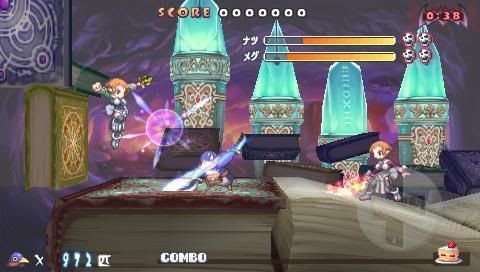
Nippon Ichi have struck solid gold with their mascot design. Introduced in the Disgaia series, the Prinnies are a race of stitched-up, peg-legged penguins with the ever-uncertain demeanour of a race that has an odds-on chance of exploding every time they sneeze, and sport the kind of cuddly physique that makes their tragic deformities oh so hilarious. Their facial expressions waver between sweat-dripping fear and the vacant stare of the soon-to-be-deceased, and their lot in life is to be mown down by the indistinguishable thousands for the most inane reasons. Truly, they are the mascots of the twenty-first century, simple and gaudy enough for the kiddies with a veneer of hopeless dispensability for the adults, who have long since realised what an asshole Crash is and want to force his vacuous, shit-eating grin into a meat grinder.

The result is a game that balances black humour and genuinely colourful charm and does so beautifully. Nippon Ichi weave an epic tale of a Demon Lord of the Underworld who has mislaid her pudding; in no way petty or malicious, she sends an army of one thousand
Prinnies on a mass-suicide mission through the Underworld to make her another one, acknowledging the fruits of their sword-slashing, Prinny-combusting labour with no encouragement or praise whatsoever. The Prinnies hack their way through each level with such grace and charm that you can forgive its faults just to see their adorable faces scrunched up in determination, usually just before their explosive demise. By mid-way you find yourself chanting along as they yell their lines with wholly unwarranted optimism, their personality so infectious and overblown that it takes the sting out of the many, many deaths you will suffer along the way, while the music plays itself across your brain long after you turn off the PSP. For sheer personality, Prinny has no trouble reeling you in.

Have Nippon Ichi crafted a genre-defining masterpiece? No, but for a company whose expertise lies in thoughtful, turn-based RPGs to dive straight into a frantic action-platformer with apparent ease is more than enough reason to clamour for a sequel. The ridiculous plot is echoed in a fantastically morbid lives system in which 1-UPs are non-existent and you have an army of one
thousand to complete the entire game with. The Prinnies run and jump with the X button, while attacks are dispensed as fast as you can mash the Square button; a smattering of vehicles and explosives smear on an extra layer of gameplay to top things off. The Prinnies have a basic ground slash and an aerial attack that hurls energy beams from their swords, which explode in a flash of blue energy on contact. As the ground attack extends roughly three pixels in front of you, the aerial attack will be your weapon of choice; that means jumping, which is at the heart of the Marmite-wide discrepancies in review scores for this game. Although they are armed with a double jump, the Prinnies can't change direction once they are airborne, and how well you take to that particular quirk of precision will define exactly how ball-gnashingly aggravating you find the game; sadly, that isn't the only difficulty to overcome.

Prinny starts off promis
ingly with each level graded in difficulty. It is only once you get a level or two in that you discover that the difficulty is notching itself up across every single area, and you suddenly find yourself wondering if you should go from the top of the list and watch the difficulty curve soar or clear the later levels first and take a few hard knocks at the beginning as you try to adjust. Whichever you choose, you soon find another set of levels thrown on to the pile that far outstrip the others in frothing, console-throwing madness, and it culminates in a boss rush capped by a villain who is immune to your most useful technique, has jaw-dropping amounts of health and only allows three minutes in which to defeat him. We all love a challenge, but not when the reward is Carpal Tunnel.

Whether or not Prinny is worth the asking price for a new game depends ultimately on your tolerance for maddening hikes in difficulty and a flagrant disregard for physics, but it is most definitely worth playing in the first place. The characters, along with the entire premise, are overblown to the point of idiocy, but always with a knowing overtone. For memorable charm Prinny has to rank as one of the best experiences on PSP, and while it is clear that Nippon Ichi still have things to learn about anything that doesn't involve isometric grids, they attacked this project with such enthusiasm that it would be a shame if they weren't given the chance to try again. For that reason Prinny is worth at least some of your time, even if you don't last the whole distance.

Verdict
It lays down a challenge that many won't see the end of, but Prinny is so full of charm and enthusiasm that it is worth a piece of your time, however much or little that may be.

Friday, 10 April 2009

Price rises, or: how to shore up your towering money throne

Having rennovated their headquarters with bricks made from wads of money, Nintendo have decided to raise the price of the Wii in the UK, citing depreciation of the pound.

Call me cynical - pernickety, even - but I feel the need to poke a few holes in their fiscal policy. Nintendo are alone amongst the big three in never having made a loss on their current-gen hardware, and have sold far more consoles than either of its rivals. Not only that, but they haven't yet needed to drop the price of the Wii, and have reduced the cost of hardware production by forty-five percent. In other words, Nintendo have been shitting out gold bullion from day one while Sony and Microsoft were scrabbling for spare pennies down the sofa to afford a few more hard drive units. The only possible danger to Nintendo is that the amount of cash they are making might be downgraded from 'obscene' to 'staggering'.

While the DS continues to play home to some truly excellent handheld titles, I can forgive Nintendo a lot of things. But raising the price of existing hardware models is a pretty naff precedent. Sony eviscerated the PS3 one year into its life span while Microsoft settled for charging obscene amounts of money for proprietory hardware, but losing money on every console they sold is a not entirely unreasonable excuse for doing so, and they have never upped the price on a model. Please guys, don't be the first to set a bad example.

Saturday, 28 February 2009

Noby Noby Boy

The creator of Katamari tries for brilliance and comes up short

Katamari was a slice of pure, distilled insanity, but on some vague level it still made a strange sort of sense to roll around in a giant, planet-purging ball like those rollers for removing cat hair. It may have had madness slathered all over with an over-enthusiastic trowel and it may have been a glorified way of getting you to do the hoovering, but at least there was method to Katamari’s madness. And if Noby Noby Boy is anything to go by, method is increasingly the last thing on Keita Takahashi’s mind.

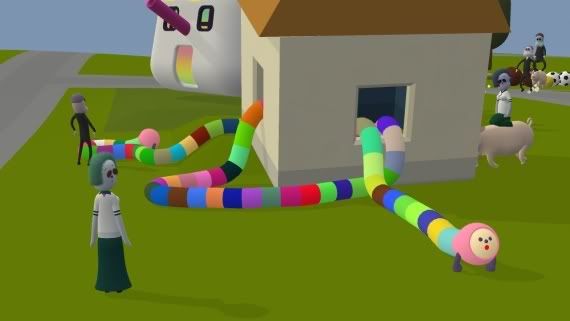
To call this thing a mess would be doing it a kindness; absolutely nothing about it makes sense on any level. The titular Boy is a small pink phallus who lives in a dimension-warping house that spurts out bubbles, and spends his days eating bicycles and shitting them off cliffs. The left stick moves your ass (figuratively), the right stick also moves your ass (literally) and a combination of the two lets you part buttocks from brain cells and stretch to enormous lengths. The face buttons see almost no use, while the shoulder buttons are used for everything and often require you to perform both actions and camera control at the exact same time. If that sounds unnecessarily complicated then you’re in possession of a few marbles more than the dev team.

You could be forgiven for thinking that Takahashi had no clue what he was doing with Noby Noby Boy for the entire length of its development, and it shows. Camera control involves so many different combinations of buttons and analogue movement that the chances of you even vaguely aligning the camera as you want it are almost nil, not least during those moments when the camera decides to leave you running about off-screen before finally deigning to swing round in your general direction. Menus are even worse; scoffing at the ridiculous notion of having everything laid out in neat sections, Noby Noby Boy forces you to control a 2D version of yourself who runs rampant through the text, barging letters out the way and occasionally eating them for good measure. The fact that you can drop him behind the text where he can’t do any damage is a blessing that soon fades as you realise that a game with nothing to do has hundreds of lines of text to wade through in a long and pointless list in order to tell you about it. And that’s assuming you’ve had the patience to sit through the first loading screen, which must surely last longer than that of Fallout 3, a game one thousand times the size and with a thousand times the detail of Noby Noby Boy, as well as approximately the same load times; it doesn't take a startling measure of intelligence to see that there is something desperately wrong here.

There’s not even a thing to do once you hit the game proper. People sit on your body for shits and giggles, then run away the next minute as you chow down on their friends and watch them collect in lumps at the base of your body. Then you fire them out your backside, and they go about their day. That’s it, mission accomplished; go to the next level and repeat until a vegetative state kicks in. Maps generally feature at least one or two potential points of interest, such as UFOs with claws hanging underneath and giant springs with balls balanced on top, but you can’t do anything with them. They just sit there as a mocking reminder of what happens when you let a genius squander two years on something that should have been knocked up in half a year by a penniless indie team.

Noby Noby Boy has one saving grace in the name of longevity, and that is its genuinely intriguing method of progress. By jumping repeatedly, both Boy and his buttocks can fly up through the cold, empty sky to meet the Sun, who lets him give up whatever body length he has achieved and add it to the length of Girl, another penis-shaped monstrosity who grows like Pinocchio’s nose (among other things) through space. With her overall length being contributed to by every player, Girl is already getting pretty sizable at several hundred million metres, and just recently made it to the Moon! Congratulations to everyone involved! Takahashi claims that by reaching new planets there will be new content unlocked, but since the Moon levels offer nothing that the original levels didn’t I highly doubt that such a thing as ‘content’ will ever grace Noby Noby Boy.

It’s hard to know what else to say; the game is simply a mess at every step. The controls are horrendous, the menus confusing, the load times ridiculous, and the content non-existent. Artistic vision gets so badly in the way that the whole thing suffers at ground-level. Even the most meandering and pointless game ultimately has something to work for, a point which Noby Noby Boy illustrates with aplomb by ensuring that the new levels opened up by Girl’s trip to the Moon offer absolutely nothing new. It has a unique and quirky charm that’ll keep you smiling for whole minutes at a time, but once you’ve eaten a few chickens and waddled off the level edge a couple of times you‘ve seen the lot.

People are already throwing excuses at it: ‘it’s not meant to have a point, it’s just throwaway fun’, and ‘it’s quirky and cute, that’s all that matters’. And that’s all they are: excuses. Noby Noby Boy has been in development since at least mid-2007, and the result of this endeavour is a lurching monstrosity of an engine that can’t load a tiny, textureless patch of land faster than Fallout’s immense, post-apocalyptic landscape, a terrible control set with barely a grain of thought behind its layout and an experience ripe for interesting quirks that tantalises but never lets you touch.

At £3.19 it’s unlikely to make you feel desperately robbed of your cash, and it at least admits its incomprehensibility right off the bat, even if it’s less willing to acknowledge its many technical issues and design faults. If scooting your ass away from your body and farting out bicycles sounds like the greatest use of your time since discovering the pin number for the locked channels on Sky, then by all means spend your money and be entertained. Just don’t expect the fun to last long, or for the global progression to bring anything new to the table.

Verdict
Big on charm but small on everything else. At a miniscule price point you might as well give it a whirl if the fancy takes you, but hopping on Youtube will tell you everything you need to know within a minute. As much as it wishes to rank itself amongst the elite of quirky gaming, it misses the point entirely by not even having one. With no substance behind the style, it is a missed opportunity.

Friday, 2 January 2009

Sonic Unleashed

A tidy engine helps transform another flawed outing into something promising

It's a fairly pointless exercise by this point to list Sonic's many ailments, but I will anyway because I share Sonic Team's love of kicking a dying animal when he's down. Lower back pains have crippled his once sprightly acrobatics, cranial damage ensures his only social interaction is with other mental degenerates, and the radiation of all those gems he insists on hoarding like a rapid magpie have at last taken their toll and transformed him into Cousin It. It's a bewildering relief, therefore, to find that Unleashed shows a few signs of competence beneath the usual aggrevations.

Unleashed shows potential for Sonic's future, bearing in mind that 'potential' doesn't always have 'realised' glued in front of it. Sega appear to have listened to the baying public for once and the menagerie of squeaky Saturday-morning side characters has been through a brutal culling, with a grand total of four regulars making an appearance and the rest presumably toiling in the salt mines of Nightopia. But apparently Sega weren't listening hard enough, because what people have been crying for more than anything else is for that never-ending roster to stop growing, and Sonic Team are nothing if not set in their ways. Irritating twat-du-jour is Chip, a small, purple and entirely superfluous midget who dispenses barely-useful advice and spends most of the game distracting you with his antics (and I use that term loosely) during cutscenes. He's even more pea-brained than Big, a character who spent the entirety of Sonic Heroes picking his nose and asking his bogeys if they were his lost frog.

It's a curious situation where so many aspects of the game have been tightened up, and yet so many others continue to breed and fester. Needless gimmick this time around is Sonic's ability to transform into a werewolf when the sun goes down, a feature that meshes together with the standard run-and-jump mechanics like a pair of stickle-bricks being handled by a baby. The daytime sections are beautifully crafted epics, with sprawling cities and vast landscapes blurring past you at cheek-flapping speeds, while the night-time sections are slow, crammed solid with enemies and far, far too long. Annoyingly, this trade-off of good and bad pretty well sums up the entire game. Ultra-sonic speed has been balanced by unwieldy hubs and aggrevating item collection, and the loss of characters has been compensated for by some of the worst dialogue committed to paper. But despair not, devoted fans and slavering fan-fic writers, because this is the first Sonic game to step into 3D that actually feels whole and complete.

Unleashed marks the first time that everything has come together on a technical level for the series; the graphics are smooth, the animations superb and glitches rare enough to qualify for the endangered species list. Moreover, after numerous games that wavered drunkenly from the ultra-arcadey to the super-realistic, Sonic Team have finally found a tone that works for the series, nestling firmly at the Pixar end of the spectrum with enough pace and cool to satisfy everyone else. The charmingly cartoonish design makes for pleasing eye-candy amongst the broken glass of the gameplay's sweet jar, and embues the series with a much-needed vitality that sits comfortably alongside the slick presentation. There are moments such as the excellent Egg Beetle boss where you'll blur through the trees, deftly side-stepping rockets and kicking a robot three miles down the road in a somersaulting mess, where at last it all comes together. The speed, the movement, the music, the atmosphere... For the first time you get a genuine feel for being Sonic, even if you're struggling to keep pace at times. And while some of the old tat you wish they'd given up on somehow continues to amble through life with a clean bill of health, so much has taken a turn for the better that if Sonic Team could just learn to drop the moments of instant death and irritating side characters then they could have a pretty competent game on their hands. The chance for a Super Mario 64 moment is dead and buried, but Sonic's 3D epiphany may yet have its moment. Unleashed shows, if nothing else, that Sonic Team finally have the technical competence and the correct grasp of tone to carry their flagship series in the direction it needs. If only they could hire an actual script writer, I might even be tempted to care about the story as well; probably best not to get too hopeful.

Verdict
Aggrevating as always but finally starting to find its feet, Unleashed requires as much patience as ever to slog through, with the rewards for doing so greater than before. Much better than their last effort, which admittedly isn't saying much.