Friday, 8 October 2010

Sonic 4: Episode 1

After years of experimenting, Sega return to what they know best

Let's start with some context: I have roughly a dozen beta versions of Sonic 3, including the 3c beta that represented Sega's last-ditch effort to fit the game on to one cartridge before splitting the second half into Sonic & Knuckles. I have a screencap of the old Sonic 1 title screen where Sonic had a human girlfriend called Madonna. I know that in the first teaser trailer for Sonic 4, they used Sonic's beta sprite from Sonic 2 instead of the one that made it into the finished game. Sonic Crackers, Sonic-16 and Sonic Eraser - every one an obscurity, and still I hunted them down.

Now that we have my fanboy credentials in order, I have to say that as much as I still enjoy the original games, they're not so perfect that a reinvigorating update isn't in order. The physics are far too weighty, there's not much in the way of collectables, and later titles like the Advance series showed that there's more to be wrung out the classic Sonic template with newer tech. And Sonic 4 does exactly that.

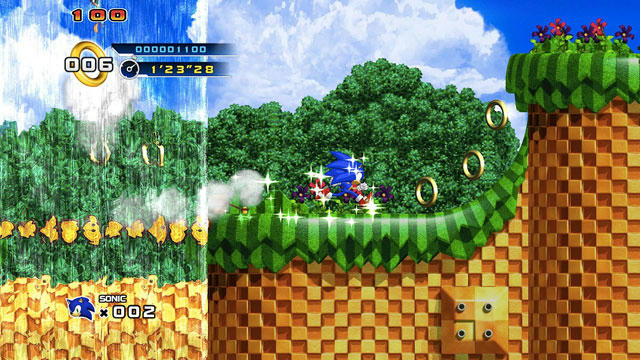
Following directly on from Sonic 3 and its follow-up Sonic & Knuckles, this is Sega's take on New Super Mario Bros - a fusion of classic gameplay with more modern series elements, and for once the intrusions into the Sonic formula blend together well. Get stuck on a slope in 1991 and you were due a tedious traipse back down the hill so you could get some speed up. In 2010, Sonic feels far lighter and nimbler, practically skipping from one platform to another, yet his top speed is still limited to accommodate the multi-path exploration that made his classic titles feel so adventurous. Homing attacks and speed boosters are present from his Adventure days, but they're complementary rather than essential, letting Sonic hit springs instantly and jump to full speed without his trajectory or lack of inertia breaking flow where once it would have.

This fusion pervades Sonic 4, from gameplay to visuals; netting a continue gives you the same miniature Sonic sprite and celebratory jingle from Sonic & Knuckles, as pixellated and imperfect as ever, and it feels genuinely charming when it could have been glaringly out of place. The music comes as a slight disappointment then, given that it occasionally falls into the territory of imperfect imitation that the rest of the game so skilfully avoids, but there are a few jingles that rank among the franchise's best, and fans are sure to notice the tap-tappy drum beats of the Megadrive sound bank. It's a niggle that is noticeable purely for the quality around it, and that's something we haven't been able to say of Sonic in years.

Which isn't to say that the design is airtight and seamless, mind you; the balance between obvious imitation and fitting homage is definitely skewed the wrong way at first, but manages to right itself as the game goes on. The physics are reasonably well judged but wildly inconsistent, with Sonic happily strolling up vertical surfaces, and while segmenting the bosses into two slightly different forms has been a staple of the 2D games since Sonic Advance, it at least came with some amount of subtlety back then rather than drawing as much attention to it as possible; Sonic 4 occasionally lays on its new-and-old veneer a bit thick, but with fans baying for the old days, this is probably the closest Sega can come to recreating the feel of the original games while keeping things slick enough for newcomers and those who are slightly less anal about the hedgehog's past.

2010 seems to be the year that Sonic fans have been waiting for - consistently positive coverage of what could be the first genuinely excellent 3D game, Sonic Colours, and a strong retro revamp in the second dimension. I never felt that the 2D games needed fixing, and would still love to see more from the Advance and Rush series, but not only is Sonic 4 a tidy and fun title, it also demonstrates a keen awareness from Sega of every age their flagship franchise has gone through. That alone may be the key difference that has so suddenly changed Sonic's fortunes, and long may this new state of play continue.

Verdict
Sonic 4 isn't ground-breaking or innovative, but it is great fun and so very, very Sonic. A fitting start to the successor of the Megadrive classics, if a little pricy for its length.


Wednesday, 8 September 2010

Gaming PR 101

Grit your teeth and let those irritating adverts pass - they may be the key to attracting new gamers and keeping the games we love

Three days moving flat and five days gluing a rubber snout to your face and claiming to be a lizardman takes a lot from you, so it isn't surprising that I haven't watched a lot of television lately. The fact that a building company dropped half a mile of flats in a direct line from my aerial to the transmitter didn't help much either, so it's fair to say that I've missed out on a lot of television this past year. Now that I'm blessed with an aerial socket that actually works (and a fridge that doesn't stink of rancid milk, and flatmates who don't leave entire baguettes floating in dish water, which largely sums up why I moved in the first place) I've finally been able to discover that Nintendo's horrifying trend in advertising continues unabated.

No other form of media has to put up with this condescending bullshit. Where normally you'd be thrown a half-minute handful of reasons to hit the cinema, in the world of Nintendo, a movie trailer would consist of a group of asinine cretins guffawing and ribbing like the extras in a second-rate musical, followed by a mother and child enthusing about the whizz-bang effects for the kids to coo at, and how it was gentle enough for Gran to enjoy, and how the protagonist taught her the importance of staying true to yourself. And then Professor Layton stops the film halfway through so they can solve a puzzle.

It's this need for justification that really irritates me, because what it boils down to is that video games aren't allowed to be fun for the sake of fun. If they aren't exercising your brain, pumping your arms or keeping your social life afloat then there has to be an ulterior motive for playing, like deciding who does the washing up, which for the benefit of any non-UK gamers is literally the reason why two people are playing New Super Mario Bros Wii in a current advert. I wish I was kidding, but this is the state of play for less-than-hardcore gamers who don't want to be labelled as such.

Worse still is the UK advert for Bowser's Inside Story, a game that mashes Rampage into an RPG with two plumbers manning the valves for maximum Godzilla-sized fun. There's adventuring to do, we're told by today's motherly shut-in, but also some puzzling. Sorry, what? 'But' there's some puzzling? What the hell does 'but' mean? Is she so ashamed of enjoying a whimsical adventure that she has to justify it with puzzles? Nobody minds that Transformers or Avatar are essentially brainless with no real need to switch on your noggin, because no-one expects them to be anything more than a few hours' worth of mindless distraction. For the Wii generation, this apparently isn't enough to justify their new hobby.

But the sad truth is that all of this condescension is completely necessary, and may be one of the most incisive decisions Nintendo has made for the gaming industry. Mario has emerged from the Wii generation as hardcore as he has ever been, a fact that will become apparent to anyone who plays his games, regardless of how they are marketed. People can claim all they like that they're trying to be social or training their brain, but they're still popping fireflowers at Koopas and calculating the entry point of a turn to drop a banana peel at, and Mario is still the Godfather of gaming - fatherly and friendly, but ready to throw you to the lava pit if you press so much as one button out of turn.

What I despise isn't the way that gaming is denigrated, but the fact that this approach is necessary in the first place to (hopefully) drag gaming out of its ghetto. This is a necessary step on the road to mainstream acceptance, a way of normalising traditional video games by changing perceptions and weaning new gamers off of content-lite casual fluff. Like comic books - which in the case of Marvel and DC are as tangled as ten years' worth of Christmas lights - gaming is still insular enough that we tend to forget how mystifyingly scary a 16-button controller can be, and that dying instantly in Modern Warfare can be jarringly unpleasant instead of an expected part of the game. Having witnessed someone throw their Wii remote into the air in a blind panic during a session of WarioWare, it's easy to see why Cooking Mama got its foot in the door, despite being essentially the same as WarioWare but fifty times slower and painfully drawn out in every possible way. Swapping lightning reactions for sluggish hand-holding is a poor trade-off, but when you don't know Mudkips from Master Chief it's the only way to remove the stress of the angry swarm of sounds and images coming from your TV.

And there's the key word: stress. Video games are like the drill sergeant from Full Metal Jacket; they beat you and harass you, they punish you for not following their rules, pace or skilfulness, and generally favour those with a faintly masochistic streak. Most video games are a pleasant challenge in the same way that Everest is; invigorating for the seasoned pro, yet so insurmountable to novices that they're barely going to consider more than a brisk walk around the foothills. It isn't just non-interest that keeps people from gaming, it's seeing the same thing from a completely different perspective. It's no wonder that games are being marketed like the Andrex puppy when they're more like the Rottweiler that savaged next door's cat.

And that's why we need these adverts. They're simpering and condescending, but if we can get just one octogenarian to upload a speedrun of New Super Mario Bros, then they've done their job. And it'll be a better world for gamers everywhere.

Friday, 13 August 2010

Bioshock Infinite Announced

The Bioshock series thus far has taken us through a city built with both the best of intentions and a healthy dose of insanity at its core, with nostalgic 1960s design drowning in the eerie darkness of one man's madness. It should come as no surprise that the next instalment continues with the same basic theme.

What is surprising, though, is for Infinite to be set 20,000 feet higher and bathed in brilliant sunshine; the open skies have given rise to more varied architecture, with quaint terraced housing in evidence amongst skyscrapers held aloft by gigantic dirigibles, while the fresh air gives stark contrast to the claustrophobia of underwater Rapture. It would be easy to forget that this is Bioshock, if not for the hulking, blood-thirsty monstrosity whose presence opens the trailer.

While nothing has been confirmed yet, don't expect to see Bioshock Infinite until next year, though a multi-platform release seems likely. Watch this space for more info.

Sunday, 1 August 2010

Earthworm Jim HD

A perfect conversion - but is it still a perfect game?

Reality just can't match the wackiness of cartoons, which is pretty much why they still exist. The incredible horsepower of modern consoles has been good to us, but while modern remakes of Mega Man X and Castlevania have stayed true to their source, it's a rare LittleBigGame that captures the soul of pastel-bright animation with polygons.

After years of 2D remakes in 3D clothing, it's refreshing to play a retro classic so obviously in love with its roots. For better or worse, Earthworm Jim HD is as beautiful, manic and frankly insane as the day it was made; the original captured Saturday morning cartoon visuals perfectly, and they are all the better for being in HD. Jim's animations are easily the match of contemporaries like BlazBlue, and the high fidelity polish has been applied to visuals and sound alike.

Jim has aged well, then. But if we're being brutally honest, his first outing wasn't without its problems, and while they haven't really gotten worse with time, they're just as annoying as you remember them. A useful edge-grab that hoists you back on to platforms is all that stands between you and a controller-damaged flatscreen, as you struggle constantly with collision detection apparently designed to mock everything that decades of gaming have taught you. There's little to the controls beyond jumping, swinging and shooting, yet hitting enemies is a pain, targeting swing points is finicky and you always seem to fall off platforms with one step left. A pixel-perfect update is no bad thing, except when a touch more pixel-perfection would have improved things by a small but significant margin.

The best example is For Pete's Sake, where you aim to protect Peter Puppy as he skips obliviously through meteor showers, pitfalls and killer plants. The meteors will break your thumb, as you have to cycle through at least three directions of fire with the d-pad, fast enough to create a barrier against the relentless hail of rocks, while the precision needed to keep Peter Puppy on solid ground verges on the ridiculous. Combine this with a badly overused chase level, occasionally aggrevating bosses and some truly obnoxious enemy placement, and you'll begin to appreciate why no-one feels nostalgia for the patience needed of the mid-'90s gamer.

Which isn't to say that Jim HD is a bad game, merely one that approaches its conversion a little too perfectly. Bungie-battling over a monster infested lake and riding a bloodthirsty hamster are as fun today as they were yesterday, and as with all games of its kind, practise eases the pain. A brand new multiplayer mode and three exclusive bonus levels show that the series is still capable of its own creative flair; an ill-judged Keyboard Cat parody comes across as a little sterile, especially compared with the game's own Evil the Cat, but head-whipping a demonic granny into fumbling for her glasses is classic Jim all over. It bodes especially well for an updated sequel, which was a distinctly tighter package all round, and a brand new instalment hasn't been ruled out. Jim HD is by no means a perfect game, but as a timely reminder of the joyous insanity that gaming used to revel in, it's the perfect nostaliga piece.

Verdict
Too stubborn to make the improvements it needs, Earthworm Jim HD manages to hold up well nonetheless. The low price point should make it an obvious purchase for fans, and a consideration for others.

Saturday, 24 July 2010

Mega Man Universe Announced

The Blue Bomber returns, confuses millions

What the hell is Mega Man Universe? Just about any theory based on the mystifying teaser trailer is plausible, from a Mega Man-centric Capcom nostalgia-fest to a LittleBigPlanet DIY version of the standard Blue Bomber experience.

Given that it is being developed for download on PS3/360 but NOT for Wii, could it (whisper it) be an Invisimals-style affair for Xbox Kinect and Playstation Eye, using the gamer's lounge as a playing environment, or using real world objects for Mega Man's weapon upgrades? With everything from claymation to cardboard cutouts gracing the trailer, and the tagline 'Your world. Megafied', it's as good a theory as any. Hell, MMU could be a mash-up of every rumour going. Mega Man may not have the status to spark a thousands rumours from one game title alone, but an equally mystifying interview certainly seems to have done it.

Mega Man Universe is due for release on 360/PS3, with a date yet to be nailed down. Expect a preview later in the year.

Sunday, 18 July 2010

Preview: LittleBigPlanet 2

It does credit to the community surrounding LittleBigPlanet that, having so thoroughly exhausted the vast resources available to them, a sequel is warranted just two years later. A constant stream of DLC has swelled the enormous arsenal of textures, stickers and other creative pieces that have contributed to almost three million user-created levels, spawning at a rate of almost four thousand per day; LBP must surely rank with Second Life and Garry's Mod for sheer unbridled passion from its fanbase, to the point that a game that didn't seem to warrant a sequel this generation is in sudden need of one.

While LittleBigPlanet aimed to let players create stand-alone platform levels, enthusiasts soon started exploring far beyond these bounds, with working calculators, side-scrolling shooters, musical renditions and a complete recreation of Contra emerging from what is essentially a digital mash-up of Lego and Mechano. With that in mind, Media Molecule have begun removing the limiters from their saccharine marvel; a flexible camera allows for top-down gaming and fully directable cutscenes, logic-based AI makes the fiddly task of programming complex enemies a much simpler task, and new options allow for entire games to be created, not just individual levels.

The core of the game remains unchanged, but as with the original, a myriad of features both great and small are likely to be explored in amazingly creative ways by a community that is hungry for more. The visuals have been given a subtle overhaul as well, with the engine from God of War 3 giving a much smoother and softer edge to the atmosphere, and hopefully eliminating the occasional slowdown issues that an overly-ambitious level could generate. Even in pre-release shots, the game is noticeably prettier.

LittleBigPlanet 2 is set for release in November, and if the last two years have taught us anything, PS3 owners are about to be surprised in ways they never thought they would be, all over again.

Thursday, 24 June 2010

Bridging the Gap

The gaming industry needs a massive change of perspective to gain true mass-market appeal

Nintendo managed to get the casual fluff out of the way pretty early on in their E3 conference, and given the retro-soaked smorgasboard of wonder they served up afterwards this is probably a good thing. If they thought that anyone was going to be fooled by another Wii Sports repackaged with Mario characters then they had another thing coming, and the ripple of applause that wouldn't have troubled a goldfish that followed the announcement of Wii Party was an invitation to move on at best. But what really got me was hearing Reggie Fils-Aime desperately describe Wii Party as a 'bridge game' that will supposedly give newer gamers a boost into more traditional fare. That's a lot to ask from the most unfortunately-titled game ever made.

Sorry Reggie, but Wii Party isn't a 'bridge' game. For starters, bridges go both ways, and Wii Party is only going to remind experienced gamers exactly why they're staying on their side of the river, namely that devoting an entire mini-game to one action is unutterably tedious. More importantly, the very concept of a bridge game is incredibly fatuous, as though the gaming world map is divided squarely into Casual County and the Kingdom of Hardcore, with a raging torrent in the middle that we haven't yet worked out how to cross.

For a true bridge game, look no further than Heavy Rain. Its critics will tell you that the game is an over-blown QTE-riddled cutscene, because that's exactly what it is - and is brilliant as a result. Heavy Rain doesn't so much bridge the river as fill it in, and the reason is that it provides a key experience that gaming is sorely missing. A triple-A blockbuster grounded in the prime-time TV thriller, Heavy Rain's story-driven approach strips away the usual video game fluff that gamers are so used to having that we have trouble wrapping our brains around the idea of losing them; Heavy Rain treats the control pad as an intuitive way to interact with a story, not as a system of rules whose mastery is an end in itself. There's no high score, upgrades or inventory screen; with the only goal being to enjoy the story and reach the end, Heavy Rain barely qualifies as a game, while stopping short of being a film. Hell, why can't it be both?

We've spent so many decades calling these things 'games' that when a project like Heavy Rain comes along we just can't shake the assumptions that the entire industry has ground into us from day one, before it could even be called an industry. Any gamer salivating over The Last Guardian knows full well that they won't be playing it to clobber enemies, solve puzzles or nab a few Trophies; as with predecessors Ico and Shadow of the Colossus, the real reward lies in the absorbing atmosphere, the sorrowful world and the emotional punch that Team Ico's dual-protagonist approach has always conjured. The actual 'game' elements play second fiddle to the mark it leaves etched in your heart, and yet The Last Guardian runs the risk of becoming another mild sleeper hit because its approach to interactive media jars with what we expect that media should be.

The result of all this is the laughable mess we have today, where anything not designed for young males with their balls where their brains should be is assigned to either the casual ghetto or the arthouse shanty town; because gamers who want to cultivate an area rather than blow it up and raise animals instead of braining them are a relatively new mass-market, the industry assumes that their inexperience means they either want or need to be treated like simpletons, and by extension don't care about getting a high-quality experience. The glorious HD graphics, thumping surround sound and searing narratives are reserved for the gamers of the old-school, while the less masochistically violent are left to play Farmville, with the only commercial alternative of any note being Harvest Moon. And we're surprised that this new market of supposedly casual gamers doesn't stick around?

That we assume they don't care for games because they find them uninteresting rather than pathetically insipid is both self-destructive and utterly cretinous. Gaming demographics are far more varied than we once thought, and shows a thirst for interactive entertainment across generations and genders. But for gaming to truly succeed as a medium, it needs a new Heavy Rain far more than it needs a new Halo. The big blockbusters will still be the real chart toppers - just look at Hollywood. But like film, and television, and literature, video games have to approach every new project as its own entity, with no obligation to conform to mechanical stereotypes, and they need to stop treating their patrons like idiots. Inexperience and indifference are two entirely different things; learning that one simple lesson could be the true key to seeing the gaming industry flourish.

Tuesday, 8 June 2010

Presenting: the next generation of button mashers

If anyone still had any doubts about how Natal was going to work in the hands of the average man, Parade magazine has got you covered. Your toes would curl from the embarrassment if you weren't already crying with shame.

On the one hand, it's a classic example of people with absolutely no clue of what they're doing, trying to do the thing they can't do with as much enthusiasm as they can muster; why the woman feels the need to fire off all four limbs in a neverending fit is something known only to her. On the other hand, it's depressingly similar to how those exact same people use the Wii, believing that raw energy is somehow a substitute for accuracy as though the mysterious whirring box under their television is a sentient robot from a 1940s sci-fi serial.

Of course, anyone who has played a video game for more than an hour will be well aware of this, but then they'll likely be too busy wondering how a large, sweeping motion is in any way quicker, more accurate or more useful than a button press to actually get around to buying Natal themselves, rendering the whole thing a ridiculously expensive exercise in bandwagoning.

Thursday, 27 May 2010

Sonic shows his Colours

True to form, the blue blur refuses to slow down as a second game is added to the Fall 2010 release window alongside Sonic 4, oddly named Sonic Colours. Gameplay is a mixture of 2D and 3D, which immediately screams Unleashed; with no werehog in sight, it's probably going to be better recieved than that particular outing.

Throughout the game Sonic can collect Wisps, a group of day-glo aliens captured by Dr Eggman. By combining different coloured Wisps, Sonic can unlock new routes and secret areas. The trailer is brief, but after four main console games that were either depressingly grey or overly serious, it is genuinely refreshing to see a Rush Adventure-esque title that cuts loose with a bright palette and a bouncy soundtrack.

Sonic Colours will be out later this year for Wii and DS. No word yet on how the two will differ beyond a few excusive Wisps, but as the first Sonic crossover for the two platforms it will surely use pointing and touch in no small amounts. Keep an eye on the Sega blog for news as it comes.

Tuesday, 25 May 2010

PSP: The Next Generation

Take note, Sony

With Natal, Move and the 3DS all guaranteed centrepieces for the upcoming E3 expo, hardware news is going to be at the heart of the summer months. Rumours are flying that Sony will announce a successor to the PSP, and despite some fairly convincing arguments that Sony are going to play it pig-headed as usual, they can hardly afford not to; the PSP has sold well, with as many units sold as the Wii and far more than its big brother, but software sales are poor. If Sony don't at least mention the PSP2 then they might as well throw in the towel now; announcing it later in the year will make it seem like a hasty block against Nintendo, and locking horns with their rival will be the best exposure they can get. As someone who loves his PSP like you would a well-meaning yet oafishly clumsy child, I'd like to think that Sony will try their best not to shoot themselves in the foot by being caught unawares, as impossible as that might seem since Nintendo have given them months of warning.

The PSP is a good console, but there are some hard lessons to be learned from it, and it isn't inconceivable that Sony could take a bite from the DS fanbase with a smart new console (not to mention a few iPhone/iPad users). But to stop the PSP2 from playing catch-up from day one, Sony need to take care of the following:


1) A multitouch screen
Four hardware iterations, a bold download-only model and a raft of new Store features, including a comic book reader and online video rentals - all have played their part in the PSP's brief resurgence. But while the iPhone hasn't entirely proven its gaming credentials just yet, Apple's device has established touchscreen hardware as the only real way to sort and consume your media on the go. Touchscreen is the least Sony need to include if they want the PSP to be recognised as an all-purpose media hub, but to really cement the image they need to match their competitors, and for portable media that rival is Apple.

2) A Cell-powered processor
This is probably a no-brainer, since Sony invested a lot of capital into the technology and still need to see returns from it. A quad-core processor would give developers a slightly stripped-down version of the PS3 to play with, ensuring good use of the tech right from launch, and is probably the most cost-effective hardware Sony can use right now. But there's something even more important that Cell would allow the PSP2 to do:

3) Better connectivity with the PS3
I've said it before, and I'll say it again: Remote Play was a shot in the arm that Sony never gave the PSP. Taking current, cutting-edge console tech on the move, with every improvement and feature that hardware gains over time, is something that no-one else is doing, and best of all is that it could be linked to a Cell-powered PS4 as well, making the handheld future-proof. The Cell processor was designed to communicate with other Cells with incredible ease (hence the staggering performance of the Folding@Home project), and its inclusion could be the key to making the PSP2 a true extension of the PS3, and an essential one at that. Of course, to make that work they'd need to:

4) Sort out the buttons
Without beating around the bush, the PSP's analogue stick is terrible. It's badly placed, awkward to move and easy to lose grip of. But that isn't the only issue; the PSP is just one stick and two buttons shy of the DualShock's layout, but that difference was enough to forever marr Remote Play's credibility by crippling Lair. A second, more well designed stick shouldn't be hard to implement, and two discrete triggers placed below the current L/R shoulder buttons on the handheld's rear would clear up all existing control issues a treat. How far the PSP needs these additions is up for debate, but if Sony want the PSP to emulate the bigger consoles then it may as well have the control scheme to match.

And once Sony have made these improvements, there's just two more matters left to clear up:

5) Backwards compatibility with PSP games
Outrun 2006 is one of my favourite PSP games, so its complete absence from the Playstation Store hasn't sat all that well with me. A secure, encrypted UMD converter that lets you transfer games via USB is going to be an essential purchase, much like the PS2 memory card adaptor when the PS3 first hit the stores. That is, until Sony give us:

6) More essentials, faster
God of War. Resistance. Motorstorm. Final Fantasy. Metal Gear. LittleBigPlanet. All these and more took great, even essential, series' and gave them fully-fledged installments that stand tall with their console brethren. But there need to be more, and they need to come thick and fast on launch day before gamers forget to even bother checking the console's release schedule.

PSP exclusives like Crisis Core and Metal Gear Solid: Peace Walker have started to erode the notion that handheld titles can't be as essential as console games, but that line of thinking needs a serious push, if Sony's typically costly hardware is going to be seen as justifiably expensive rather than unnecessarily overpowered. The upcoming E3 will hopefully prove whether Sony can produce a better future for the PSP, or if history is doomed to repeat.