Monday, 25 April 2011

Where next for consoles?

As all three manufacturers announce new consoles for release within the next three years, what can we expect from the next generation of consoles?

How have consoles and games grown in the last generation? A wider variety of controls like Kinect, Wii Remote and multi-touch; better social tools like Steam groups, friends lists and Facebook updates; a sideways leap into movie rentals, digital comic books and television services; even smaller, indie games like Braid, Limbo and Stacking have gone from being marginal titles to some of the biggest on the download stores.

Video games are changing fast and no-one is entirely sure what the next big step will be or when it will hit us. Consoles of the future are therefore in need of flexibility and reactivity, with as few stumbling blocks to unexpected change as possible. With that in mind, I'd propose the following improvements for the next wave of hardware:


Wednesday, 9 March 2011

1.5 is the new 2.0

Are console bolt-ons the next step?

The console life cycle has started wobbling in the last couple of years; there's barely been the faintest hint that a new home console is on the way, and if the Kinect is anything to go by then Microsoft, at least, is more interested in shoring up the 360 than moving on to another console. And let's be honest here, exactly what point would there be to a new console? The Wii is suffering from an image problem rather than a lack of horsepower; a HD upgrade and an enormous GUI overhaul would be a better option than dropping the console entirely. And as for the PS3 and 360, what would a better model offer? Once upon a time you could look to the ever-advancing PC and arcade markets to see where better capabilities would improve the play experience, but what do either of them offer that consoles don't? Crysis 2 does little new in raw mechanics despite looking pretty as all hell, and the underlying physics aren't proving much of a problem for current gen consoles. And despite native support, console gamers still aren't giving a single shit about the potential of the keyboard and mouse combo. Most of the current innovations in gaming are coming through firmware patches, peripherals and the online arena; what part of that equation requires a new console?

Tuesday, 22 February 2011

Fruitbat's week: Chiptunes, Mega Man 2.5 and real life Mario Kart

Let's set the mood with a bit of music: through the 80s and early 90s, chip music was the definitive way of delivering catchy beats in your game; because consoles weren't able to play music files like a CD player could, they had dedicated audio chips into which a set of data was fed, which told the console what sounds it should play - like playing the piano from sheet music, essentially. Take that same chip data and port it to another console and you'd have a similar but slightly different sound, like this Megadrive port of Super Mario Bros. It's a fascinating way of creating sound and the distinctive digital beeps are still alive today, in modern music, the retro reboots Mega Man 9 and 10 and the chiptune scene, notably Anamanaguchi, who gave the Scott Pilgrim game its soundtrack. I'm still yet to find anything that tops the very best of the NES era, but that just goes to show what can be achieved with the right talent. So, please check out the video for a few examples of original compositions, or try this one to see how Capcom are still kicking it old school as late as 2010.

With those bleeping in the background (or not) this is the perfect time to introduce Mega Man 2.5, a fangame that throws the 8-bit Blue Bomber into a Paper Mario-esque world of perspective-warping platforms. Speaking as someone who has waded in the rough waters of fangamedom before, it doesn't surprise me in the least to see that progress is going slowly, but while the announcement of this fan-built game is pretty old, a recent trailer definitely seems to comfirm that development is in full swing. The game seems less ambitious in its scope than the original video, which, given the state of progress thus far and the creator's grounding in animation, definitely seems to mark it out as proof of concept rather than a playable game. But with a full co-op mode, calls for more programmers and enormously expansive levels, this has the potential to provide an outing for the series that will rival the upcoming Mega Man Universe in originality. The fangame scene has only been growing stronger, with enormous groundwork laid out by Sonic fans trying to recreate the complex physics of the hedgehog's adventures, and this marks a step beyond mere recreation and delves into the realm of savvy reinvention; definitely one to keep an eye on.

And since we're on the subject of re-imaginings, here's a video of a Frenchman bringing Mario Kart into the real world to a worryingly insane degree.

And that's all until next time.

Thursday, 27 January 2011

Meet the NGP

PSP successor confirmed

About five hours ago, Sony held a press conference in Japan to announce the PSP2, also known as the NGP (Next Generation Portable). Given that the current PSP had its share of misguided flaws, especially the PSPgo, it's encouraging to browse through the features currently announced and see that Sony has managed to fix a few of them, especially when I look back through my wish list of PSP2 features from early last year; there's no Cell processor in there, but a quad-core ARM processor will do just as nicely. And there's a few other things that have left me feeling impressed:

A touch pad on the rear

I called this months ago, less because I thought that Sony would actually implement it and more because it's a great idea; frankly, its inclusion has given me hope that Sony still has it in them to deliver smart hardware choices that its rivals don't offer, after playing catch up for the last few years with the PS3 and generally flailing about with the PSP.

Anyone with a modicum of hand-eye coordination will be able to match their fingers behind the console to points on the screen in front of them, theoretically meaning that we could play fully-functional touch screen games without our fingers obscuring and smudging the screen. This is a step forward that not even Apple have thought to do yet, and if it works it'll reflect well on Sony as a console maker.

Flash card storage for games, updates and DLC

The removal of the UMD is no great loss, but even better than the switch to flash drive is that all updates and DLC will be stored and integrated with the game on the same cartridge, making data transfer between systems an absolute breeze. The original PSP stores such data on the memory stick, which means that actual downloaded games tend to get lost amidst a forest of separate icons for updates and DLC; it may amount to housekeeping more than anything else, but for the sake of convenience this is an important feature.

Infinitely better analogue sticks

Aside from the fact that there are two of them, pictures clearly show that the analogue sticks are just that: proper sticks, not just sliding nubs that cripple your thumbs. They'll be more prone to damage when being shoved in bags or pockets, but I'd be very surprised if the inevitable carry cases don't account for that.

Key franchises right from the off

Enough said. Even if they don't make the console's launch, names like Killzone and Uncharted carry a lot of weight. The fact that they're on their way and comparable to their PS3 counterparts is enough to have faith that the console will have a few essential titles in its first year.

No news yet on the price (expensive) or battery life (short) or even the release date (er... not yet), but head over to Kotaku for big, glossy pictures of the unit. It sounds like a console with potential, and it'll remain to be seen if Sony can overcome its predecessor's stagnation and keep pace with the 3DS. Expect to hear more about this in the coming months.

Sunday, 28 November 2010

Gaming PR 666

No, fuck it, I've changed my mind

Do you know why Mario and Luigi had to play their adventures separately, insteading of pairing up for a two-plumber beatdown? Do you know why Tails was a superfluous nobody who couldn't lose any lives, could be left behind and got chucked out in the flaming wreck of an airplane while the first player knuckled down for the end game? Basically, do you know why certain games used to treat the second player as an annoyance that the first player didn't need?

Because for most people he was, that's why. Anyone who grew up with a games console and a younger sibling knows exactly what I'm talking about; you didn't want to shepherd them about in a game-spanning escort mission while they blundered into enemies, and you didn't want to wait fifteen minutes at every slightly tricky jump while they tried to remember that there was a jump button in the first place. You sure as hell didn't want to take turns in the single player, because you knew, every time, that they'd haemorrhage lives at a rate of three per minute, and burst into tears when you tried to wrestle the pad back off them and salvage the crumbling remains of your near-perfect run. Sega and Nintendo, each in their own way, concocted the perfect co-op for siblings; one gave the little sprat his own adventure to ruin, and the other removed any possible way for him to be a liability. With such genius did these giants bear gifts upon the grateful elder children of the world.

If you're wondering why this nugget of childhood has burst out and mugged me on the corner of memory lane, it's because I've realised what it is that's been irritating me all along about these wretched new-wave adverts and that horrifying family attempting to play Kinect through severe muscular spasms: deep down we can see those useless ham-brains we hated playing against, and there ain't no way in hell we're going to put up with that crap all over again, the problem being that this time the kids are fully grown so we can't push them over and steal the pad back off them.

For reference, go watch that Kinect video again: god, they're like a pair of giant man-babies, oblivious to the connection between interaction and action, who have grasped on to the idea that they have to move about but don't have the brains to see that that isn't enough to get them through the game. The many months since that video's release hasn't dulled the horror of realising that the children may actually be smarter than the parents.

And while I'm acutely aware that I've defended Nintendo's adverts as being necessary for this mildly uncoordinated audience, it's only just struck me how terrifying it is that adults - real, honest-to-god grown men and women - apparently need to have it explained to them, with visual aids, that playing games with your friends is fun. They're teaching that stuff to three year olds on CBeebies, yet there's an entire marketing blitz on prime time telly devoted to people who should still be only getting a spoonful of food in their mouths one time out of three. If your opinion of Donkey Kong Country Returns is swayed less by the gameplay footage than by how much Ant and Dec seem to enjoy it then we're starting to fly into flock-following sheep country.

This isn't even a rant about having to show people how to play games; hell, with new tech like the Wii Remote or Kinect it's pretty essential. No, this is a rant about the fact that games are still being marketed as though the players are dribbling cretins, only now they're about thirty years older and have bags of skittles for brains instead of raw meat engorged with testosterone, and I'm not sure if it's an improvement.

Do these people even exist? The Kinect video certainly suggests so, as does the mountain of shovelware that Nintendo have brought upon themselves, but then take a look at the iTunes charts: at the time of writing, the iPhone Top Ten App Chart contains Angry Birds, FIFA 11 and Cut the Rope, two of which are a natty pair of physics puzzlers and the other is a franchise so long-standing that it's outlasted most real footballers. The puzzlers are cheap, casual and fairly basic, but they need a good eye and a healthy sense of trajectory to progress, something that the dimwits we're being told exist couldn't begin to make head or tail of. Or maybe they could, if they first had someone lead them to it first with easy-to-follow diagrams.

So the conclusion at the end of this hazy ramble through my brain is, basically, that I have no idea what to think any more. At first I wondered if we shouldn't just give up on these people, since the current iPhone crowd clearly have a good eye for quality even in the form of five-minute fluff, but that would just be snobbish. What would be nice, though, is if we could market to casual gamers on the assumption that they actually have a functioning brain and don't need to be marketed to in the exact same manner as nine year olds. That, I think, would make me feel a whole lot better.

Monday, 15 November 2010

Sonic Colours

A magnificent effort sadly goes to show that Sonic Team have used up all their chances

One less dimension to worry about means that Sonic's 2D journey has had a lot less bumps to smooth out over the years, and while the Advance and Rush series brought their own enjoyable flavour to the franchise, his three dimensional adventures have been patchy at best; Sonic Adventure was rushed out to prop up a fledgling Dreamcast, while the sequel was rushed out to support a dying Dreamcast. Heroes was inexcusably broken, and Sonic the Hedgehog even more so, while Unleashed got half the formula right but stumbled with the rest. Sonic 4 had things easy; with expectations for Colours riding high, it's the 3D hedgehog who is yet to impress. And like its predecessor, it's a tantalising snapshot of what Sonic could be.

Colours isn't a bad game per se, coming straight off the back of the much-loved daytime stages from Sonic Unleashed in which players blasted through the level at breakneck speed, but it still manages to carry across the flaws of previous games, from flaky controls to ridiculously unfair obstacle placement and overly busy level design, all of which transform what should have been a breezy joyride into a nerve-shredding dance on the brink of oblivion. The levels are bizarrely cluttered and often ask you to take in more than the eyeball and brain can handle, and while it's many the fine game that can keep the player on a knife-edge, there are numerous cheap deaths that have an almost smug, mocking feel to them, as though half a second is clearly ample time to spot the bottomless pit that just rushed around the corner.

So far so 3D Sonic, then. It's as well that the gimmick du jour, the Wisps that grant Sonic a variety of powers mid-level, are fairly well realised and generally quite inventive; the Cyan Wisp lets Sonic ping-pong off walls at ultra-fast speed, usually clearing hoards of enemies and firing you a small but significant distance through the level, while the Yellow Wisp gives you an all-destroying drill that takes you far below the main level. The one major criticism of the Wisps is that they rarely feel organic; you can't stockpile different kinds of Wisp energy to maximise your options, and every part of each level is clearly designed around the specific Wisp power you've just picked up, even if it's an option rather than an essential.

It's a sad reflection of the fact that Sonic Team just can't quite seem to get the various gameplay elements they concoct to mesh together properly. The drifting and side-stepping from the running sections of Unleashed are back, but are only useable during specially marked segments rather than at any time. They've made an effort to merge the various modes of control into one fluid whole, but all they've done is diced them up in the same bowl rather than actively blending them into one smooth mixture.

It isn't all bad; in fact the irony is that Colours really begins to shine when it learns to slow down, drop the sparkling bombardment of visuals that plague the 3D games and get down to some serious old-school Sonic platforming, measured and exploratory and never punishing inquisitiveness. The best can be seen in Aquarium Park, where speed relents in the face of a haunting, serene wonderland that spreads open around you and invites you to make a day of it. Better still is that the hard lessons Sega had to learn for Sonic 4's retro revamp have clearly made an impression, with Spinies and Motobugs making an appearance almost unchanged from their 16-bit counterparts, while the Special Stages, disguised as a (probably unintentionally) nightmarish arcade side-scroller are all based on the distinctive level design of Sonic 1, from the odd curves of Starlight to the treacherous platforms of Scrap Brain, and these elements feel entirely natural and organic with not a single knowing wink thrown in their direction.

Moreover, the colourful aesthetic is still paying off two years after Unleashed, and while Sonic's new English voice is diabolical, it's at least helped by a script that has thrown all of the po-faced seriousness of previous games out the window while still maintaining the eye for scope and scale that makes Sonic consistently feel epic. Detail abounds at all levels as Sonic Team somehow channels the same technical forces that power every first-party Wii game, something they are clearly aware of as a delicate touch gives depth to the visuals, from the deep blues that illuminate the first dash into Aquarium Park and the gentle tff-tff-tff that sounds as Sonic scatters petals and grass blades on the Wisp home world.

Despite this, Colours is not the salvation of the Sonic series. Not quite. It isn't ambitious enough in its mechanics, and Sonic Team plainly lack the skills required to take Sonic any further forward. Although the series clearly still has an enormous well of lifeforce yet to be tapped, it isn't Sonic Team who are going to get there; they're like an ageing thoroughbred that refuses to be put out to pasture, and the fact that they're making small improvements doesn't mean they're going to keep pace with the prime fillies any more. Colours is a defiant statement that Sonic still has life left in him, but he needs a strong team behind him, and Sonic Team isn't it. There's a strong creative force at Sonic Team that's bursting to show us what they can do, but a lengthy spell with an equally passionate third-party dev is the only way for Sonic to reach his peak.

Verdict
An aggravating first play means it isn't worth renting, but it is worth buying if you can push through to the end game; Colours is short, flawed and symptomatic of a team that simply doesn't have what it takes no matter how hard it tries, but amongst the cracks can be seen a franchise straining to become what it knows it can be.

Friday, 8 October 2010

Sonic 4: Episode 1

After years of experimenting, Sega return to what they know best

Let's start with some context: I have roughly a dozen beta versions of Sonic 3, including the 3c beta that represented Sega's last-ditch effort to fit the game on to one cartridge before splitting the second half into Sonic & Knuckles. I have a screencap of the old Sonic 1 title screen where Sonic had a human girlfriend called Madonna. I know that in the first teaser trailer for Sonic 4, they used Sonic's beta sprite from Sonic 2 instead of the one that made it into the finished game. Sonic Crackers, Sonic-16 and Sonic Eraser - every one an obscurity, and still I hunted them down.

Now that we have my fanboy credentials in order, I have to say that as much as I still enjoy the original games, they're not so perfect that a reinvigorating update isn't in order. The physics are far too weighty, there's not much in the way of collectables, and later titles like the Advance series showed that there's more to be wrung out the classic Sonic template with newer tech. And Sonic 4 does exactly that.

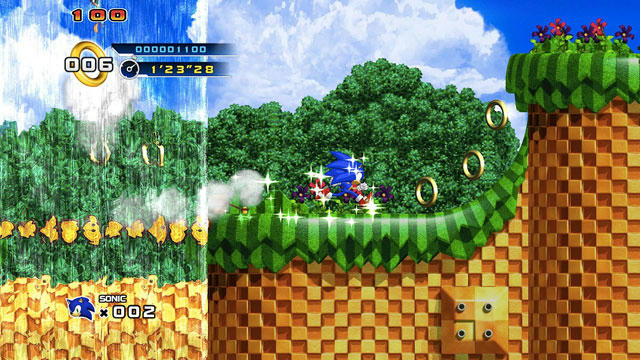
Following directly on from Sonic 3 and its follow-up Sonic & Knuckles, this is Sega's take on New Super Mario Bros - a fusion of classic gameplay with more modern series elements, and for once the intrusions into the Sonic formula blend together well. Get stuck on a slope in 1991 and you were due a tedious traipse back down the hill so you could get some speed up. In 2010, Sonic feels far lighter and nimbler, practically skipping from one platform to another, yet his top speed is still limited to accommodate the multi-path exploration that made his classic titles feel so adventurous. Homing attacks and speed boosters are present from his Adventure days, but they're complementary rather than essential, letting Sonic hit springs instantly and jump to full speed without his trajectory or lack of inertia breaking flow where once it would have.

This fusion pervades Sonic 4, from gameplay to visuals; netting a continue gives you the same miniature Sonic sprite and celebratory jingle from Sonic & Knuckles, as pixellated and imperfect as ever, and it feels genuinely charming when it could have been glaringly out of place. The music comes as a slight disappointment then, given that it occasionally falls into the territory of imperfect imitation that the rest of the game so skilfully avoids, but there are a few jingles that rank among the franchise's best, and fans are sure to notice the tap-tappy drum beats of the Megadrive sound bank. It's a niggle that is noticeable purely for the quality around it, and that's something we haven't been able to say of Sonic in years.

Which isn't to say that the design is airtight and seamless, mind you; the balance between obvious imitation and fitting homage is definitely skewed the wrong way at first, but manages to right itself as the game goes on. The physics are reasonably well judged but wildly inconsistent, with Sonic happily strolling up vertical surfaces, and while segmenting the bosses into two slightly different forms has been a staple of the 2D games since Sonic Advance, it at least came with some amount of subtlety back then rather than drawing as much attention to it as possible; Sonic 4 occasionally lays on its new-and-old veneer a bit thick, but with fans baying for the old days, this is probably the closest Sega can come to recreating the feel of the original games while keeping things slick enough for newcomers and those who are slightly less anal about the hedgehog's past.

2010 seems to be the year that Sonic fans have been waiting for - consistently positive coverage of what could be the first genuinely excellent 3D game, Sonic Colours, and a strong retro revamp in the second dimension. I never felt that the 2D games needed fixing, and would still love to see more from the Advance and Rush series, but not only is Sonic 4 a tidy and fun title, it also demonstrates a keen awareness from Sega of every age their flagship franchise has gone through. That alone may be the key difference that has so suddenly changed Sonic's fortunes, and long may this new state of play continue.

Verdict
Sonic 4 isn't ground-breaking or innovative, but it is great fun and so very, very Sonic. A fitting start to the successor of the Megadrive classics, if a little pricy for its length.


Wednesday, 8 September 2010

Gaming PR 101

Grit your teeth and let those irritating adverts pass - they may be the key to attracting new gamers and keeping the games we love

Three days moving flat and five days gluing a rubber snout to your face and claiming to be a lizardman takes a lot from you, so it isn't surprising that I haven't watched a lot of television lately. The fact that a building company dropped half a mile of flats in a direct line from my aerial to the transmitter didn't help much either, so it's fair to say that I've missed out on a lot of television this past year. Now that I'm blessed with an aerial socket that actually works (and a fridge that doesn't stink of rancid milk, and flatmates who don't leave entire baguettes floating in dish water, which largely sums up why I moved in the first place) I've finally been able to discover that Nintendo's horrifying trend in advertising continues unabated.

No other form of media has to put up with this condescending bullshit. Where normally you'd be thrown a half-minute handful of reasons to hit the cinema, in the world of Nintendo, a movie trailer would consist of a group of asinine cretins guffawing and ribbing like the extras in a second-rate musical, followed by a mother and child enthusing about the whizz-bang effects for the kids to coo at, and how it was gentle enough for Gran to enjoy, and how the protagonist taught her the importance of staying true to yourself. And then Professor Layton stops the film halfway through so they can solve a puzzle.

It's this need for justification that really irritates me, because what it boils down to is that video games aren't allowed to be fun for the sake of fun. If they aren't exercising your brain, pumping your arms or keeping your social life afloat then there has to be an ulterior motive for playing, like deciding who does the washing up, which for the benefit of any non-UK gamers is literally the reason why two people are playing New Super Mario Bros Wii in a current advert. I wish I was kidding, but this is the state of play for less-than-hardcore gamers who don't want to be labelled as such.

Worse still is the UK advert for Bowser's Inside Story, a game that mashes Rampage into an RPG with two plumbers manning the valves for maximum Godzilla-sized fun. There's adventuring to do, we're told by today's motherly shut-in, but also some puzzling. Sorry, what? 'But' there's some puzzling? What the hell does 'but' mean? Is she so ashamed of enjoying a whimsical adventure that she has to justify it with puzzles? Nobody minds that Transformers or Avatar are essentially brainless with no real need to switch on your noggin, because no-one expects them to be anything more than a few hours' worth of mindless distraction. For the Wii generation, this apparently isn't enough to justify their new hobby.

But the sad truth is that all of this condescension is completely necessary, and may be one of the most incisive decisions Nintendo has made for the gaming industry. Mario has emerged from the Wii generation as hardcore as he has ever been, a fact that will become apparent to anyone who plays his games, regardless of how they are marketed. People can claim all they like that they're trying to be social or training their brain, but they're still popping fireflowers at Koopas and calculating the entry point of a turn to drop a banana peel at, and Mario is still the Godfather of gaming - fatherly and friendly, but ready to throw you to the lava pit if you press so much as one button out of turn.

What I despise isn't the way that gaming is denigrated, but the fact that this approach is necessary in the first place to (hopefully) drag gaming out of its ghetto. This is a necessary step on the road to mainstream acceptance, a way of normalising traditional video games by changing perceptions and weaning new gamers off of content-lite casual fluff. Like comic books - which in the case of Marvel and DC are as tangled as ten years' worth of Christmas lights - gaming is still insular enough that we tend to forget how mystifyingly scary a 16-button controller can be, and that dying instantly in Modern Warfare can be jarringly unpleasant instead of an expected part of the game. Having witnessed someone throw their Wii remote into the air in a blind panic during a session of WarioWare, it's easy to see why Cooking Mama got its foot in the door, despite being essentially the same as WarioWare but fifty times slower and painfully drawn out in every possible way. Swapping lightning reactions for sluggish hand-holding is a poor trade-off, but when you don't know Mudkips from Master Chief it's the only way to remove the stress of the angry swarm of sounds and images coming from your TV.

And there's the key word: stress. Video games are like the drill sergeant from Full Metal Jacket; they beat you and harass you, they punish you for not following their rules, pace or skilfulness, and generally favour those with a faintly masochistic streak. Most video games are a pleasant challenge in the same way that Everest is; invigorating for the seasoned pro, yet so insurmountable to novices that they're barely going to consider more than a brisk walk around the foothills. It isn't just non-interest that keeps people from gaming, it's seeing the same thing from a completely different perspective. It's no wonder that games are being marketed like the Andrex puppy when they're more like the Rottweiler that savaged next door's cat.

And that's why we need these adverts. They're simpering and condescending, but if we can get just one octogenarian to upload a speedrun of New Super Mario Bros, then they've done their job. And it'll be a better world for gamers everywhere.

Friday, 13 August 2010

Bioshock Infinite Announced

The Bioshock series thus far has taken us through a city built with both the best of intentions and a healthy dose of insanity at its core, with nostalgic 1960s design drowning in the eerie darkness of one man's madness. It should come as no surprise that the next instalment continues with the same basic theme.

What is surprising, though, is for Infinite to be set 20,000 feet higher and bathed in brilliant sunshine; the open skies have given rise to more varied architecture, with quaint terraced housing in evidence amongst skyscrapers held aloft by gigantic dirigibles, while the fresh air gives stark contrast to the claustrophobia of underwater Rapture. It would be easy to forget that this is Bioshock, if not for the hulking, blood-thirsty monstrosity whose presence opens the trailer.

While nothing has been confirmed yet, don't expect to see Bioshock Infinite until next year, though a multi-platform release seems likely. Watch this space for more info.

Sunday, 1 August 2010

Earthworm Jim HD

A perfect conversion - but is it still a perfect game?

Reality just can't match the wackiness of cartoons, which is pretty much why they still exist. The incredible horsepower of modern consoles has been good to us, but while modern remakes of Mega Man X and Castlevania have stayed true to their source, it's a rare LittleBigGame that captures the soul of pastel-bright animation with polygons.

After years of 2D remakes in 3D clothing, it's refreshing to play a retro classic so obviously in love with its roots. For better or worse, Earthworm Jim HD is as beautiful, manic and frankly insane as the day it was made; the original captured Saturday morning cartoon visuals perfectly, and they are all the better for being in HD. Jim's animations are easily the match of contemporaries like BlazBlue, and the high fidelity polish has been applied to visuals and sound alike.

Jim has aged well, then. But if we're being brutally honest, his first outing wasn't without its problems, and while they haven't really gotten worse with time, they're just as annoying as you remember them. A useful edge-grab that hoists you back on to platforms is all that stands between you and a controller-damaged flatscreen, as you struggle constantly with collision detection apparently designed to mock everything that decades of gaming have taught you. There's little to the controls beyond jumping, swinging and shooting, yet hitting enemies is a pain, targeting swing points is finicky and you always seem to fall off platforms with one step left. A pixel-perfect update is no bad thing, except when a touch more pixel-perfection would have improved things by a small but significant margin.

The best example is For Pete's Sake, where you aim to protect Peter Puppy as he skips obliviously through meteor showers, pitfalls and killer plants. The meteors will break your thumb, as you have to cycle through at least three directions of fire with the d-pad, fast enough to create a barrier against the relentless hail of rocks, while the precision needed to keep Peter Puppy on solid ground verges on the ridiculous. Combine this with a badly overused chase level, occasionally aggrevating bosses and some truly obnoxious enemy placement, and you'll begin to appreciate why no-one feels nostalgia for the patience needed of the mid-'90s gamer.

Which isn't to say that Jim HD is a bad game, merely one that approaches its conversion a little too perfectly. Bungie-battling over a monster infested lake and riding a bloodthirsty hamster are as fun today as they were yesterday, and as with all games of its kind, practise eases the pain. A brand new multiplayer mode and three exclusive bonus levels show that the series is still capable of its own creative flair; an ill-judged Keyboard Cat parody comes across as a little sterile, especially compared with the game's own Evil the Cat, but head-whipping a demonic granny into fumbling for her glasses is classic Jim all over. It bodes especially well for an updated sequel, which was a distinctly tighter package all round, and a brand new instalment hasn't been ruled out. Jim HD is by no means a perfect game, but as a timely reminder of the joyous insanity that gaming used to revel in, it's the perfect nostaliga piece.

Verdict
Too stubborn to make the improvements it needs, Earthworm Jim HD manages to hold up well nonetheless. The low price point should make it an obvious purchase for fans, and a consideration for others.